My students sometimes trip over course terminology. We define Frameworks as metaphors for creative problem solving on B822. I encourage students to do a bit of method acting and imagine the role that they inhabit when problem solving.
I think everyone tackles problems from an individual mindset or belief about how the world works and what enables problems to be solved. This view determines their choices about how to approach problems and what techniques to use.
Most people seem to be unconscious about their Framework and sort of assume that the world actually works the way they believe it does. When my students are asked to make their Framework conscious and explicit, some of them choose to change the metaphor or analogy slightly to be make it more effective and include other people.
Years ago I did a lot of consultancy and training for the rail industry. Though British Rail was derided in the media, I met a few superb managers and lots of hard working people doing their best to maintain a transport system that functioned well.
Some managers led their teams through bomb threats and sabotage by the IRA and showed great skill in outwitting the terrorists. Others took tedious, bureaucratic quality systems and boiled them down to a useful, practical essence that their staff could understand and implement with enthusiasm. As a result railway staff, who had been dismissed as old codgers, now became a powerful force for positive change.
The unconscious Framework guiding this problem solving seemed to be 'Problem Solver as Football Coach' and BR had some budding Sir Alex Fergusons in their midst.
During the early incarnations of the Crossrail project, some managers tackled the issue of 'one man train operation' with some success. They subverted the bureaucratic meetings of labour relations and drew on personal contacts and relationships based on trust to persuade unions to adopt a different work pattern. The implicit Framework seemed to be 'Problem Solver as Networker'.
During and after privatisation, a lot of fuss was made about the new broom sweeping through the rail industry, with the appointment of senior managers from the commercial sector. The cynical view (in common with privatised electricity companies) was that failed managers from the oil industry found a safe haven in deregulated transport and utility companies.
I didn't work with the newly appointed titans of the rail industry, but certainly witnessed interactions between them and their staff as well as external consultants. They seemed to share a tendency to view people as problems. The Framework that comes to mind when I recall this era is 'Problem solver as Neanderthal'. These high testosterone managers seemed to have a very small toolkit for problem solving and most often used a large rock to try and crush the problem (or verbally bludgeoning their people.) This might work in the short term, but did nothing for long term cooperation and motivation.
In recent consultancy work in organisations that have driven down the demographic of supervisors and managers, I am seeing youngsters managing people who are older and more experienced than them. I witness a lot of 'Problem Solver as Dalek', where some of the youngsters seem scared and rigid, expecting their staff to carry out work exactly as they used to do it. Part of my task is to help them let go of their robotic approach so that they relax and set goals, freeing staff to find their own way of reaching them. Increasingly strident and fixed commands and reproaches cut no ice with people who believe they could do the same job better, faster and with less friction.
Dr Who may be brainy and have centuries of wisdom on which to draw, but he does involve his team in finding ways to get the job done.
Showing posts with label metaphor. Show all posts
Monday, 23 January 2012
Framework for Problem Solving
Sunday, 22 January 2012
Sticky Metaphors
I encourage my students to include metaphors and analogies in creative problem solving. One of the reasons is that a good metaphor can be sticky and stay in the minds of colleagues much longer than wordy powerpoint presentations or reams of data.
One example of how this works in society is the notion, now shared by most primary school aged kids, that saturated fat clogs our arteries (like chip fat poured down the drain) and makes us fat. If this were so, then it should follow that all our cars would become clogged by the oil we regularly pour in their engines.
Here's an eminent endocrinologist, Dr Robert Lustig, explaining what actually causes obesity:
If you stop someone on the street and ask them to explain evolution, they're likely to describe it as survival of the fittest an evocative description of how random mutation works in evolution championed by biologists such as Richard Dawkins.
The biologist Lynn Margulis died in November. It took nearly a decade and 15 rejections before the Journal of Theoretical Biology published her paper presenting the process known as symbiogenesis, by which organisms cooperate in development rather than always competing. One of the examples she cited was mitochondria, which are organelles within cells that generate most of the chemical energy needed by the cell. Mitochondria have many properties characteristic of bacteria (including reproduction by binary fission) and their DNA resembles that of bacteria.
One example in the human body is the appendix, which was thought to be a vestigial organ from the days when we ate rabbit food. Bill Parker, Professor of surgery and Duke University School of Medicine, is undertaking research that indicates the appendix may be a reserve of beneficial bacteria for the gut (symbiosis in action.)
Sticky metaphors can block fresh thinking and become orthodoxy that resists new research presenting contrary evidence.
In creative problem solving, sticky metaphors can lure colleagues away from rigid thinking to consider the status quo from a new, more dynamic angle that leads to critical thinking and action. In a previous post I mentioned the power of animal metaphors in describing the state of the company. The animal can help us talk about company problems without personalising them.
During a creative problem solving workshop a comic analogy (such as the above Gary Larson cartoon) may arise that seems to have no benefit or use in the process. If it persists, I encourage the group to revisit it and consider how it might contribute to the challenge at hand.
If it sticks, run with it.
Monday, 25 April 2011
Fancy a quickie?
I like to present clients, students and blog readers with simple, memorable ideas. I make this choice, not because I think these people are stupid, but to help those interested in the subject, who lead busy lives.
Typically in problem solving I tend to use a knocked down version of the Buffalo Group creative problem solving method. Instead of 6 phases, I work with 3 + 1. Depending on the circumstances I may or may not make the method explicit. People don't always want or need to see and understand the workings of the internal combustion engine to get from A to B in a car.
When I make the method explicit, I often use the analogy of human sexual relations to clarify the stages. CPS comprises the 3 diamonds: problem exploration, idea generation, implementation + monitoring and evaluation. In the metaphor this translates to: foreplay, intercourse, climax + 'How was it for you?'
(Robert Brasington kites have full and knock down representations of the Buffalo Method. NLP fans may note that they facilitate movement in stuck problems by lifting people's focus out of the Kinaesthetic realm skywards.)
John Cleese gives an interesting lesson in sex education in the film ' The Meaning of Life', (shown here with Portugese sub titles). He states that the purpose of foreplay is to make intercourse easier:
During the practical demonstration he tells the class to 'take foreplay as read', because they covered it in a previous lesson. Unfortunately many of my clients and students wish to do the same, because they find the techniques fascinating and tend to think that creative problem solving happens when ideas are flowing. They haven't covered it in a previous session, so find that idea generation is more difficult or doesn't help resolve the problem.
Human seduction and sexual relations depend on the individual/s concerned. What works for one, may leave another cold. Erogenous zones for one person may be tickle centres for another and create distance between the partners. A problem may seem straightforward on the surface but comprise a number of interconnected parts. If there is a high degree of what Rittel/Mason & Mitroff describe as Wickedness, then work must be done to find a way in to tame it. There may be a number of different areas of a problem that can be tackled but some may lead to fruitful outcomes and others to blind alleys. If there is limited power or scope to influence a particular area then it may be better to move on to parts that are amenable to change.
Sometimes the problem is in the viewer. An issue can be looked at from different angles or reframed so that it becomes more manageable. Dr Abhay Bang reflected on an overwhelming problem and asked himself: 'Do I really need to solve all the problems, all the links in the chain of this cause of death?' I started to think: 'Where is the weakest link I can attack?' The problem owner may also be part of the problem and progress could be made by considering what he/she could do to change him/herself.
A problem well defined is a problem half solved is a useful way of considering the first phase of the method or foreplay.
This notion is sometimes greeted with a groan (much like the schoolboys' response when John Cleese threatens to set an exam.) This assumes that the method will take a long time and require lots of hard work (ie boring.)
It ain't necessarily so.
Sex isn't always the same in terms of quality, quantity or duration. Foreplay can be a long drawn out meal with lots of flirting and interaction or may take the form of a fierce argument between partners. Partners may not always reach a climax and solo sex is also possible. A look, a brief exchange and heightened attraction may do it, as Eban Page explains in his 'cocky and funny' dating system under the name David DeAngelo (aimed at nerdy guys who can't get a date.)
In creative problem solving problem exploration/definition can be done over time in a variety of conversations and contexts. It's possible to snatch little bits of time here and there and I've witnessed successful work done in corridor conversations or water cooler exchanges. Appropriate techniques can be introduced quietly without labelling them as anything special. People are pulled in by the energy and fun of tackling something in a different way, particularly if the problem is entrenched and stuck.
Counter intuitive techniques can be particularly effective in warming up colleagues to the idea of tackling something difficult. Steve Jobs believes people are inherently creative, but need opportunity and tools to unleash this. 'Not tonight, Josephine, I have a headache' can be challenged in various ways. When we open to the possibility that our colleagues might be more creative than we think, we can run creative problem solving processes on the sly and see what emerges. Something as simple as a metaphor can stimulate thinking that is unconstrained by the heavy weight of the real problem - 'What would Homer do?'. A simple reverse brainstorm can also clear a log jam in thinking: 'How can we make this problem catastrophic?'
The method can be run through fast, revisiting one or more phases later for further iterations.
Heinz latched on to the idea of rapid problem solving and snatching opportunities where we can in the famous soup commercial, commenting on male stamina:
'Ready in two minutes'
Labels:
creative problem solving,
creative problem solving techniques,
metaphor,
method,
reflection,
Rittel
Thursday, 24 March 2011
Intellectual fingerprints
Jim Collins uses this term in crediting Peter Drucker's influence on some of the most famous innovative companies such as Hewlett Packard, an organisation built on values.
Drucker did not follow the tendency to make a Procrustean Bed from theory, fitting the data to what had been proposed in abstract. He began with empirical data based on the observation of people and organisations in practice and then reflected on the role of organisations in the evolution of society at this stage of human history.
One distinction Collins makes is between the tendency to answer questions of increasing irrelevance with increasing precision and Drucker's courageous drive to ask questions of increasing significance and find answers with increasing empirical rigour.
Collins takes the view that the overriding question is 'How do we make society more productive and more humane?'
If you build great, well-managed companies and destroy human beings in the process, this would be a failure.
Collins discloses how his team of young, sceptical students challenged his ideas and pushed him into research on Level 5 leadership.
Collins challenges received notions of underprivilege used to explain poor success in society, citing examples of level 5 leadership enabling people to triumph over adversity.
In scenario thinking he uses the metaphor of climbing a mountain to describe our present state in a world of ferocious change. We are climbing at 20,000 feet in a storm and far from base camp. Collins believes we will return to prosperity, but not stability. The storm may pass, but there's no return to base camp. Developing countries have long experience on the side of the mountain and are better skilled than we are in dealing with this environment.
One of the challenges for rising generations is in dealing with change and restriction over time, without expecting rapid development or a speedy return to better conditions.
He quotes Admiral Stockdale's account of time spent in a Prisoner of war camp in Vietnam and his claim never to have been an optimist during that time:
'When you're imprisoned by great calamity, great difficulty and great uncertainty, you must never confuse the need for unwavering faith that you will find a way to prevail in the end and the discipline to confront the most brutal facts we actually face.'
Labels:
change,
Collins,
creative management,
Drucker,
leadership,
metaphor,
organisational culture,
reflection,
scenario thinking,
values
Tuesday, 22 February 2011
Losing control of the customer
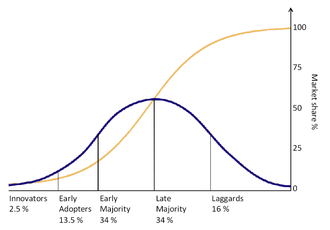
Everett Rogers published the Diffusion of Innovations in 1962, which clarified how people respond to change and new products.
Companies developed systems for launching innovations and building customer response. The film industry relied on critics to help sell films to audiences. Company web sites included reviews and customer comments. An expert system helped the flow of information and opinions to steer consumers in the desired direction.
What happened?
Amazon and eBay developed systems to include customer reviews on their sites. Consumers became accustomed to giving and receiving feedback from non experts about products and services. Company stooges were relatively easy to spot and ignore in making purchase decisions. These initiatives spawned a range of sites that included consumer reviews and feedback.
What happened next?
Other sites included a forum or discussion boards. Single issue fora focussed discussion around specific products and services. Other web sites included discussion boards about a range of topics and people had space to exchange views on a variety of consumer experiences. Regular visitors to these sites tended to ask fellow members for tips rather than turning to company websites.
What else happened?
Youtube hosted videos that showed how products worked. Some were made by the manufacturers, others by happy or dissatisfied users. Organisations and individuals began to show instruction films on how to do a range of things, including converting Youtube videos to audio files. Some were spoof reviews.
Peer to peer networking increased and companies were viewed as one element of the range of information sources available. Consumers might visit shops or websites to view the product, but looked around for the most competitive price online.
How did organisations respond?
Companies participated in discussion boards in 2 ways: 1) Staff provided helpful information and responded to feedback in positive and constructive ways, 2) Companies took web site hosts to court for publishing inaccurate or defamatory content. Some sites are now more cautious about content provided by consumers in contentious areas. Word gets round about the second tactic and does not boost sales.
Recently I emailed Apple about a problem with their product, which seemed to contravene consumer legislation on description of goods. They fobbed me off by directing me to tech support. I wrote to the Chief Executive (based in the USA) and the UK customer services manager was on the phone to me within a few days. She told me this was the first time she had heard a complaint about this particular problem. I pointed out that people had been discussing the issue for the last 4 years on their own web site fora.
If you don't use your own resources for listening to the customer, then they'll go elsewhere. If you don't or won't provide a solution to their problem, they'll find someone else who will.
Pubs may be closing every week in the UK, but people are finding virtual bars and cafes to gather, build relationships and exchange ideas about products and services. Even government experts no longer dominate:
The late majority and laggards may still respond to conventional systems, but the other 50% of the population comprising innovators, early adopters and early majority have voted with their feet and fingertips.
Russell Ackoff describes the evolution of companies from organisms to communities, in which people below elect their leaders. Perhaps the marketplace is evolving from distinct demographic strata into communities that are proactive and share ideas across demographic boundaries.
Customer relationship management (CRM) has become increasingly complex as customers don't necessarily gravitate to a company's website for information or to complain about their products.
Seller beware!
Labels:
change,
communication,
customer service,
diffusion of innovation,
empowerment,
environmental scanning,
innovation,
knowledge management,
metaphor,
Russell Ackoff
Friday, 12 November 2010
The Dodo company and other animals
Analogies and metaphors give us clear pictures separated from reality and the complexities of detail. They enable us to step into an alternative world, play with it and then make the links to the current situation.
This is particularly helpful when the real situation is highly politicised, rife with conflict or discussion is seen as threatening. Metaphors help us distinguish the wood from the trees as we back up and see the big picture.
Stephen Berry's book 'Strategies of the Serengeti' describes a range of types of organisation using the metaphor of wild animals.
I use this as part of my toolkit with young managers who hold onto an illusion of 'the ideal company' and think their organisation could and should change rapidly to some textbook ideal. Once we work with an animal metaphor, it can be easier to accept reality and work out how to deal with it in concrete terms.
Sometimes hybrid animals emerge from the test and the idea of equal strengths in 2 areas.
The wild animal metaphor has enabled managers to broach delicate subjects with colleagues and make progress in key areas to improve organisational health.
One of my clients was dismayed to realise that the organisation resembled a lame wildebeest, which ran the risk of being picked off by a cheetah, lion or hyena. Presented with this startling picture, colleagues were more willing to discuss an overhaul of strategic direction and marketing.
Take the test at his site to discover which animal your organisation most closely resembles.
Labels:
change,
climate,
metaphor,
organisational culture
Friday, 29 October 2010
Who is creative?
Many people think of artists, writers, product designers and marketing professionals.
I believe that creativity and innovation show up in all walks of life, but may look different in each domain.
Here's a BBC radio 4 documentary, which explores creativity and innovation in tax avoidance. Who are the creative people in this area? Bankers, accountants, multinational companies.
The tax gatherer's dilemma? 'It's like a fat policeman chasing a Ferrari'.
Subscribe to:
Posts (Atom)