Showing posts with label innovation. Show all posts

Friday, 14 August 2015

Nigel Lawson and the Green Deal

Nigel Lawson was a Conservative Chancellor of the Exchequer under Margaret Thatcher.  He presided over the Big Bang, the deregulation of the City of London and various tax cuts.


He was interviewed recently and defended his record, blaming other governments for irresponsible deregulation, which contributed to the financial collapse in the last decade.

He criticised the burden of taxes for environmental measures, claiming that taking care of resources for future generations placed unnecessary financial pressure on current generations.


The Green Deal was an initiative introduced in 2012 by the Coalition government.  It provided loans for energy saving measures and recouped the money through energy bills.  It was criticised for being bureaucratic and enriching some unscrupulous providers.

After Nigel Lawson's interview the initiative was scrapped by the Conservative government.

Was Nigel Lawson right?

I've written before about a young couple who renovated their house to Passive House standards and regret installing central heating.  Their cosy home only required two hours of heating in 18 months.  This could have been achieved with one oil filled radiator or heated towel rails.  They could have avoided lots of  pipework, radiators and expensive boiler.  Their energy bills are very low.


My local council introduced higher building standards and required more energy saving measures.  Small builders resisted and attacked them for imposing regulations that increased costs.  The same builders returned a year later to apologise.  They explained that the projects had resulted in offers of new contracts, so the increased costs were offset by the unexpected free positive PR.


Another developer was asked to install solar panels in 6 out of 10 new build flats.  He was reluctant, but agreed.  Later he returned to request permission to install panels in the 4 remaining flats.  He realised that solar helped with marketing and enabled him to sell the development very quickly.  The aim is to build and sell as quickly as possible so that the money can be used for the next project.


My local council demolished its council buildings and commissioned new offices to reflect their aim for transparency of local government.  The architects interpreted this as a request for glass boxes.  The council now has a set of very modern and high tech greenhouses, which need a lot of heat in winter and cooling in summer.  What a pity they didn't retrofit and extend the original council building.

Businesses and individuals always take time to adapt to change.  I've yet to witness an environmental regulation that hasn't been embraced by businesses and used to their advantage, contributing to the bottom line.

One business that works with local councils to help social housing tenants reduce energy bills (by simple changes) finds that tenants are enthusiastic and more likely to pay their rent, if their bills drop.  Housing officers also report that tenants in energy efficient and passive house accommodation want to  do everything they can to avoid being evicted from comfortable homes.

Sadly central and local government in the UK are far behind other Northern European neighbours in taking practical steps to improve housing stock and work premises now and for the future.

Apparently we demand the right to piss money out of windows (with poor U values).

Friday, 28 September 2012

ბრენდინგის ერი Branding a nation

I sing in a Georgian choir and am often asked to explain which Georgia it represents.

No it's not 18th century English music nor songs from a Southern United State.  If I mention Stalin, people think of USSR.


One leader has the power to evoke Georgia as a nation and that is Eduard Shevardnadze.


Georgians don't understand how this came about.  In the West we saw a succession of Soviet leaders, who seemed to be appointed because it was their turn.


They often seemed indistinguishable and equally lifeless.


Krushchev may have been chubby and cheerful, but seemed to have dead eyes.  He was most often ridiculed as the Michelin man.


Gorbachev showed greater promise, but still had a buttoned up quality.  His Minister for Foreign Affairs always stood out in television news film.  Shevardnadze appeared to have a functioning brain behind the eyes, a sense of humour and a pulse.  USSR seemed to be moving away from the film set of 'Invasion of the Body Snatchers' and appointing warm blooded humanoids to lead them.


Shevardnadze pushed for greater reform, particularly in the Republics of the Soviet Union, when Gorbachev wanted to slow down or back pedal.  He was a product of the Soviet system, but was a major driver for reform.

After the break up of the USSR he returned to Georgia and became President in his mid sixties.  He presided over a country with limited infrastructure and well established black and grey economies.  The police were corrupt and the country struggled to function, with violence, criminality and regular power cuts.  Shevardnadze avoided major military attacks on rebellious regions, which had caused such bitterness and resentment in Abkhazia under Zviad Gamsakhurdia.  He attempted to maintain civil relations with Russia and improve trading links.

His greatest achievements were in foreign policy, particularly his contribution to German reunification.


He is not admired for his attempts to hold on to power by rigging elections, although we are familiar with hanging chads, bogus voting applications and boundary changes in both the USA and the UK as some of the means for 'influencing' electoral outcomes.

Some criticise him for his failure to tackle corruption, which was widespread through most Soviet Republics.  One member of his government told me that he had the typical attitude of an old man.  Listening to this account, I was reminded of all the young men I'd met, who had strict fathers that turned into indulgent grandfathers.  Shevardnadze kept slack control of the budget and the economy suffered as a result.

Overseas we are left with the image of a handsome man with flashing teeth and twinkling eyes, who contributed to major innovation in state bureaucracy and international relations.

This contrasts with Vladimir Putin, who has become a gay icon, for his bare chested appearance in hunting, shooting and riding photos.


In 2003 Shevardnadze was tired and had tried to resign, but was persuaded to stay.  He is reported to have asked Saakashvili, when Misha came to unseat him in the Rose Revolution, 'Thank God, what took you so long?'

He continues to take an active interest in foreign policy and warns against other ways of trying to retain presidential power by participating in an attack on Iran.

History may re-evaluate Eduard Shevardnadze as a good statesman, who helped dismantle the soviet empire and emblems of the Cold War, but couldn't keep the lights on at home.


Mikheil Saakashvili is proud of his achievement in keeping the street lights shining all night on the main boulevards of Tbilisi, even if the power still shuts off sometimes in Svaneti.  He has been less successful in foreign policy and taming the Russian bear.


Sunday, 20 May 2012

Apology to Mr Wanamaker


I admit that I was one of the naysayers, who dismissed Sam Wanamaker's idea of re-creating the Globe Theatre.  I thought he was going to put Disneyland by the Thames.

What changed my mind?

Years ago I strolled along the river with a friend and we walked round the Globe theatre building.  I asked the enthusiastic student volunteers what play was being performed that evening and was told 'Pericles'.  I'd never heard of it, but they persuaded us to buy tickets.  The performance was magical.  The plot involved sea voyages and rigging was attached to the balconies, so that the audience felt as if they were on board ship.  For the first time, I understood Shakespeare's skill in catering to the aristocracy, ordinary educated folk and the raucous groundlings.


Last night the Marjanishvili Theatre of Georgia performed 'As You Like It' in Georgian as part of the Globe to Globe festival.  The cast surrounded the stage and acted as a Greek chorus, sound effects troupe, crowd, circus style side men to the few actors on stage.  I know few words of Georgian, but enjoyed their show immensely.  Sound effects were provided by simple means, such as rain sticks, singing wine glasses, triangles, drums and cymbals.

If you missed it, you can watch it online here.

How did  he do it?


Sam Wanamaker faced huge obstacles in realising his dream.  English Heritage blocked his efforts to get detailed information from their archaeological excavation of Shakespeare's original theatre nearby.  A group of thespians put their weight behind the re-creation of the Rose Theatre rather than Wanamaker's project.  Investors doubted the feasibility of the enterprise and money dried up.  Sam maintained a single minded focus on the idea and persuaded others to join him.  Eventually Sam died, but the team continued to pursue his vision.  When everything seemed hopeless, one member focussed on what benefits the Globe would bring and re-invigorated his colleagues.


The theatre is thriving today.  It receives no public subsidy.  There is a full educational programme to ensure that Shakespeare is brought to life in the hearts and minds of young people.


Congratulations Mr Wanamaker.  I'm sorry I ever doubted you.

Update:  New indoor theatre dedicated to Sam Wanamaker has been built in Jacobean style.

Thursday, 10 May 2012

Fluffy goes to Durban

I've been following the fortunes of the team pioneering HIVEX treatment for HIV in South Africa.  It sounds impossible, but this simple and inexpensive protocol seems to produce impressive results without terrible side effects.


The team have been struggling with attacks on their facility.  They have also applied for government approval of the treatment and jumped every hurdle, only to meet.....SILENCE.

The treatment stopped in April until they can get things on a more stable and secure footing.

Fluffy, a long term HIV positive Brit, flew into South Africa from the UK and experienced HIVEX for himself, with impressive results:

'After about my third day of treatment at the Hivex centre, I started feeling by far more energized day by day and needed no more ''nap's'' in the afternoon, which in London would last from about noon to 3pm every day. And when I woke up in the morning, instead of feeling like I was on an all night workout or labour camp, I actually felt fresh and energized and had no problem getting up even at 5am.
What I found most astonishing though is the fact that after I forgot to take my pain medication with me to the centre and then also forgot my evening dose of Tramadol (I have been on the maximum dose of 500mg for several years) my usual severe back and body pains were gone. 
I then on purpose left out the pain medication and have to say that I have not taken any pain killers for the last three weeks. These two very important issues of constant tiredness/exhaustion and the constant pain now gone, was worth it alone for me making the trip. Now all I want to find out is if there have been any changes to my bloods, which I will have checked on my next visit to my HIV consultant.'


He has now dedicated himself to promoting HIVEX and helping some of the rural dwellers to have a sustainable income to fund clinic visits and treatment, as well as helping orphans to develop a life off the streets.


Monday, 27 February 2012

Mr Bean and the Mac

It is well known that Martin Bean, the OU Vice Chancellor, used to work for Microsoft. Students and tutors have long complained of the OU bias towards Microsoft and Windows in computing and technical support. This has been eased over the years by software flexibility in Macs allowing dual systems.


It was a challenge marking the first electronic assignments on a Mac. When the electronic marking system was upgraded, I couldn't get it to work and had to buy a cheap Windows laptop for OU work.

Someone told me about Mike Hay and his eTMA file handler.


Mike's free download provided the easiest and most robust bit of software for electronic marking that I'd found. Not only has he compiled a clear manual, but he offers telephone support when new users get stuck. I've found him more helpful than the OU computer helpdesk. Satisfied customers are encouraged to make a donation to charity to show appreciation for his efforts.


I assume that Mike knitted his bit of kit to help with his own teaching.

What does this innovation have to do with Mr Bean? It costs the OU nothing, boosts participation of Mac users and lessens criticism of the technical monoculture at the university.

How about acknowledging Mike Hay's contribution with an award?

Monday, 5 December 2011

You must be crazy!

As a boy, Jørn helped his father build and sail small boats.


In Denmark he observed the intricacies of the natural world and marvelled at interlocking fish scales and the mechanics of a bird's wing in flight.


When he travelled abroad as an architectural student, he noticed how these details sometimes appeared in building design, such as intricate interlocking roof tiles on a grand mosque. His observations went into the melting pot and culminated in a visionary design for an important building, which he submitted in open competition.

Jørn's drawings were discarded by the panel early on in the weekend. The Finnish architect, Eero Saarinen, turned up late to participate in judging entries. He worked through all of the entries, including those that had been eliminated, and decided that Jørn's ideas were the most outstanding of the bunch. Saarinen championed Jørn's design until it was finally chosen.

Building was a major challenge. Jørn had not included any engineering slant on how his vision might be turned into reality. Danish Engineers, Ove Aarup and Partners, were brought in to find a solution. However, Jørn had included detailed consideration of elements to enhance sound and performance as well as facilities for the audience, which would take the project way over budget if included. The project was finished without Jørn, as he was thrown off the project in the middle, refushing to compromise on the detail. The building has become an iconic landmark and is famous worldwide to tourists and musicians alike. Much later the authorities began to admit that some of the additional details could be retrofitted, as they would make a significant difference to the quality of the experience.

That is the story of how Jørn Utzon designed the Sydney Opera House.


I thought about Utzon when a young Georgian architect friend told me he plans to build a financial district in his country - the City of Tbilisi. There is a long history of visionary architects and planners being thrown off their own projects mid way, so the risks of the undertaking are huge.

Meredith Belbin devised a way of considering how people work together in drawing up his Team Role Inventory. He encourages us to look at the range of functions that must be fulfilled in order to complete a project. Each of us can fulfill one or more roles. We may have functions that are strong, moderate or weak, so it makes sense to work to our strengths and find others who are strong at our weak functions.

Utzon holds the visionary or Plant function. He clearly also thinks through to the consequences of his designs down to the smallest detail, which covers the Completer Finisher function. He probably also carries out the Specialist function, in that he shows little interest aptitude for the areas outside of his own narrow field (including finance and engineering.)

Ove Aarup and Partners were brought in by the government to make Utzon's design work and held the Implementer or Company Worker function. Others sorted out the finance, when the project went well over deadline and budget and held the Resource Investigator role. There was also a driving force to ensure that the project maintained momentum and was completed (Shaper). The Chairperson or Co-ordinator role was also carried out, but seemed unable to manage the external pressures effectively.

Neglected areas seem to be those who detached themselves to check out what was happening in the team to ensure that appropriate decisions were taken (Monitor Evaluator); and those who kept the peace and ensured constructive relations in the team throughout the crises (Teamworker).

Other notable architects manage to stay the course and avoid being kicked off their projects. I suspect that, in some cases, the named star takes the role of Co-ordinator and delegates the Plant and Implementer roles to underlings, who don't ususally share the glory. This seems to be common practice in architectural firms, but Ken Shuttleworth is the most notable example of the mismatch between fame and quality of output. His former boss, Norman Foster, built the company's reputation by tackling small industrial projects in the early days.


Survivors also include engineering expertise in their designs, so they can demonstrate the HOW of the building and not just the WHAT to prospective customers. Bringing the Implementer role in-house or under their own control ensures that projects don't slip out of their grasp so easily.

Utzon's story also reminds me of how much innovation may depend on luck or serendipity. If he had not found a champion in Saarinen, then we might have a functional, but pedestrian building in Sydney harbour.

As Pinchot reminds us 'Go to work each day ready to be fired.' That seems sober and realistic advice for young visionary innovators starting out.

Tuesday, 20 September 2011

Make do and mend in the Philippines

What do you do when there's no electricity and you're poor?

In the Philippines they've started generating power with simple plastic bottles:


Litre of Light is an initiative to make solar bottle light in a country where energy prices are high.

In parts of Africa they've leap frogged the development cycle by jumping straight into mobile phone technology. Landlines and universal secure power supplies aren't necessary for telecommunications. This has also enabled many people to run businesses from their mobiles, handling payments electronically rather than having to visit a bank.

The project in the Philippines may point the way to a leap straight into sustainable energy supplies.

Friday, 26 August 2011

Orphan Brands

One misconception often held by my students is the notion that all innovation has to be revolutionary. Evolutionary change is viewed with contempt. They seem to believe that the only way to conquer the market is to devise something brand new. Blue sky thinking is rarer than we might imagine. I've written before about Apple's tendency to design things from a blank sheet of paper, but they also buy up crucial innovations as a platform on which to move forward, such as NeXt computing for a new Operating System.


Some entrepreneurs have made a lot of money from buying up neglected brands that are no longer generating large profits for multinational corporations. Their skill is in refreshing the brand by altering the packaging and relaunching marketing to boost sales and create a lucrative, steady income stream for the long term future. One product I use that was orphaned and adopted by Asian entrepreneur Mike Jatania's Lornamead company is Stergene, a hand wash liquid.

Other brands lose money because it is no longer economical to manufacture them in the West. Car brands have been bought by Chinese companies and few are now wholly owned and manufactured in Europe and the US.


'(These are).....strategic players, companies that want to expand into new areas or bulk up existing businesses. China's Sichuan Tengzhong Heavy Industrial just agreed to buy the Hummer line of SUVs from bankrupt General Motors (GM), while Penske Automotive Group, the nation's second-largest auto dealer, plans to pick up the bankrupt carmaker's Saturn brand.'

Another category that I'd include here is medication that is no longer fit for its original purpose but has been found effective for another complaint.


The most famous brand is Viagra, a medication originally targetted at angina, but was found by chance to be effective in treating erectile dysfunction.

Medical staff struggle to deal with brain cancer. Current treatments work for a small per centage of cases caught at an early stage. Other cases are merely delayed.


Researchers have identified that an old anti depressant, clomipramine, shows good results with brain tumours. A BBC Radio4 programme 'Treating Tumours: Old Drug, New Tricks' reviewed the evidence and lack of research into this treatment. As an anti depressant it has fallen out of fashion because of the side effects and been superseded by drugs such as SSRIs (the Prozac group).


As a licensed drug some cancer specialists are using where nothing else can be done for a patient, with promising results. It is cheap, the side effects are known, so clinicians argue that it's worth doing further research to check whether it's worth prescribing for this difficult condition.


Thursday, 18 August 2011

Reluctant entrepreneurs


Twin brothers, Ben and Jonathan Finn, tackled the challenge of bringing music scores into the 20th century by creating a computer programme they called Sibelius (after the famous Finn).


At first they retained it for their own use, but soon decided to capitalise on the time and effort it took to create the programme. Their plan was to hand over manufacture, marketing and sales to others, but this was no easy task. Music publishers tended to know nothing about computers and computer companies knew little about music.


The brothers decided to sell the programme from home and targetted composers. There was strong interest, but scepticism because the concept was so novel. Home demonstration of the product led to instant sales, which included the whole package including hardware and software as well as a printer.

Sales increased rapidly, but expansion was restricted to the UK because of the Acorn platform for which the software was written. Once the brothers wrote a version for Windows, exports took off.


Sibelius was bought by US firm Avid Technology in 2006. The 37 year old brothers planned to spend more time composing their own music.


Friday, 1 July 2011

Zumba

Necessity is the mother of invention.

Here's an example from Beto (Alberto Perez), a Colombian dancer and fitness teacher. One day he left the music tape for an aerobics class at home. Instead of cancelling the class, he improvised with a mixture of music tapes from his car, which included salsa and merengue dance music, inventing some new moves to go with the music. The resulting blend was a big hit in Colombia and he took Zumba around the world.

Zumba is a big hit with dancers who have transitioned into personal training.

Here's an interview with Beto, which shows how he's extended the initial product:

Thursday, 31 March 2011

Crap innovation

Here's an account of using fecal transplants to improve conditions like multiple sclerosis.


(Many thanks to prosteev.livejournal.com for the image.)


No, today is not 1 April and I'm not joking.

Research shows that bacteria in feces make a big difference to the state of health of the body. Transplanting samples from a healthy bowel can rebalance an unhealthy gut.

The Power of Poop is a podcast by Freakonomics Radio.

Once again research led to a plausible innovation in treatment. A bigger hurdle was to challenge traditional notions that all crap is dirty and should just be flushed away.

An Australian maverick gastro enterologist, Thomas Borody, treated William Kostopoulous with satisfying results. His colleague, Alex Khoruts, at the University of Minnesota, also worked with this approach to treating disease.

Wednesday, 30 March 2011

Altruism meets Everest

Marc Koska invented something to make an impact on the rapid spread of HIV and AIDS through re-used syringes:

'My motivation was half humanitarian and half wanting to see whether I could do it. I never set my sights on a Ferrari and I never wanted to be Joan of Arc; it was somewhere between the two.'

He read an article in 1984 about the problem and spent 27 years trying to invent and bring to market a device that could change the growing loss of life in the developing world. Marc devised a single use syringe.


Here's a man with A levels, who spent part of his time as a beach bum and then took casual jobs to keep himself going. The process was tough and there's little margin in selling syringes, so it was difficult to market the product initially.

'I think our product has won out because we didn’t set out to design the best syringe in the world – I designed it to be adequate and very easy to manufacture.'

Marc decided on 3 design pillars for the new syringe:

1 Make it on existing machines (with the same plastic)
2 Sell it for the same low price
3 Ensure it's used in the same way as existing syringes

His TED lecture includes examples of children recycling and selling old syringes or playing with syrings with traces of blood in them:


Who inspires Marc to keep going?

'I could have given up a number of times. I was offered quite a lot of money for the project before we even sold any, and I said "no" because it was likely to be killed at that point. The only person is the one that you look at in the mirror.'

This story highlights 2 distinct issues in developing innovations.

1 How to devise, manufacture and sell something the market needs and can use at a price consumers are willing to pay

2 How to ensure that the product or service is adopted, so that it becomes ubiquitous

Marc is aware that safe syringes will only be used when consumers demand them as standard. This is difficult in developing countries, where patients may not challenge doctors, who have high status. He noticed that his syringes were being used in one part of a Ugandan hospital, but conventional syringes were re-used in another part.

He founded SafePoint Trust to spread information to consumers about basic healthcare problems and to encourage the adoption of single use syringes everywhere.

In 2008 'After the gruelling five-day media blitz in the country in November, Mr Koska said he was able to return for a meeting with Indian health minister Dr Anbumani Ramadoss in December and leave with the guarantee autodisable syringes would be used in all public hospitals and clinics starting in April this year.'

There is no let up. The fight for basic healthcare in developing countries is tough and takes great persistence.

"When the minister said 'yes' I went outside and cried for five minutes."

Student design

Min-Kyu Choi won a prize for re-inventing the electric plug. This video shows how:

Monday, 21 March 2011

Health Messenger

An article by Elizabeth Day caught my eye as it describes a practical example of innovation adapted to local culture and conditions, empowering people with lowest status and resources.

Dr Abhay Bang and his wife, Rani, have worked for 26 years training local volunteers in Gadchiroli, a deprived district of Maharashtra, India. The idea was to treat simple health problems at home. The volunteers are called arogyadoots or Health Messengers.

Results are impressive: newborn death rate has fallen from 121 to 30 per 1,000 live births. In 1988 the death rate among children who developed pneumonia was 13%, now it has fallen to 0.8%.

The mission of their charity, Search (Society for Education, Action and Research in Community Health) was to listen to the people and find out what kind of healthcare they wanted.

'"We are very MUCH part of the community," says Dr Bang, ...."I really can't say where the line of separation is between them and me. It is research with the people, not on the people."

Cultural differences derailed efforts by NGOs to impose western models of healthcare on rural India:

'"The villagers said they were scared to go to hospital," he says. "When we asked why, they told us something fascinating. They said: 'Your doctors and nurses drape themselves in white clothes. We wrap dead bodies in white shawls. How can you save lives if you are dressed like a dead person?' They said: 'When they admit a patient, we can only visit between 3pm and 6pm and we don't have wristwatches. We don't have anywhere to stay in town, so we go back to the village. The patient doesn't want to stay on their own."'

Dr Bang ran People's Health Assemblies to consult people on their most pressing issues in healthcare and heard about the high rate of death amongst newborn babies. Local women were then trained in low tech ways of managing neonatal care and went where they were needed using portable health packs. The Health Messengers passed on their knowledge and whole communities became empowered - from consultation, codetermination to control.

He also constructed a hospital that resembled a local village so that patients could stay with their relatives. This shifted a sense of ownership to the local community.

The innovations were driven by local demands (market pull) and the increasing availability of portable tools intended for outreach care (technology push).


Dr Bang was motivated to help by the story of a young woman who arrived too late for doctors to save her baby. She related the practical challenges she faced in coping with isolation, a drunken husband and travelling to the hospital. Rather than feel overwhelmed and give up because of the enormous size of the problem, Dr Bang reflected from a systems thinking perspective:

"But then I looked at the whole situation and asked myself: 'Do I really need to solve all the problems, all the links in the chain of this cause of death?' I started to think: 'Where is the weakest link I can attack?' and that was access to healthcare." He falls silent for a moment. "It was practical compassion, not a flash of genius."

Dr Bang and his wife also campaigned successfully for a ban on alchohol in Gadchiroli district to reduce some of the problems contributing to low income, fractured families and poor health.

Friday, 25 February 2011

The Steve Jobs tango

Steve Jobs has an interesting attitude to the customer. He listens, but doesn't run after them. Lack of imagination may limit what they want. If he can suggest something they haven't thought of yet, they might go for it.


Customer pull is clearly important to Apple and Steve Jobs has thought about different types of customer, since he and Steve Wozniak first put together Apple 1 and 2 (the first for fellow computer geeks who could assemble their own hardware, the second for those who wanted the product, but needed the box, screen and keyboard to make it work.)

Technology push is not allowed to dominate Apple's output. Designers could add unlimited functionality to products, but these won't sell unless the price is affordable. Technology is no good floating around with a mass of disconnected ideas. There must be a gravitational force that pulls it together in the form of saleable products.

Jobs is well aware of unarticulated and potential customer needs, so that he doesn't fall into the trap of looking for a quick assessment of articulated and identified needs. Latent needs may be awakened through careful engagement with customers.

'You have to merge these points of view, and you have to do it in an interactive way over a period of time -- which doesn't mean a week. It takes a long time to pull out of customers what they really want, and it takes a long time to pull out of technology what it can really give.'


Steve Jobs has little interest in describing himself as Superman, the charismatic leader. The team is essential to the process. Ideas may come from anyone and the team helps weed out the rubbish and refine those that are worth pursuing. Sharing ideas helps develop them and this gives the company leverage.

'Let's say that -- for the same amount of money it takes to build the most powerful computer in the world -- you could make 1,000 computers with one-thousandth the power and put them in the hands of 1,000 creative people. You'll get more out of doing that than out of having one person use the most powerful computer in the world. Because people are inherently creative. They will use tools in ways the toolmakers never thought possible. And once a person figures out how to do something with that tool, he or she can share it with the other 999.'

Jobs defines his role as Head Janitor and he clearly steps in to take up the slack when senior colleagues leave. He has fostered a company culture that promotes excellence, but hasn't achieved it by training courses and company handbooks. He focussed on the aesthetics of the product, but also the components and how the factory was laid out.

'I mean, beyond the functional benefits, the aesthetic communicates something about how they think of themselves, their sense of discipline in engineering, how they run their company, stuff like that......(Steve Wozniak and I) We thought, why don't we take the extra few days or weeks and do it right? We had a fundamental belief that doing it right the first time was going to be easier than having to go back and fix it. And I cannot say strongly enough that the repercussions of that attitude are staggering. I've seen them again and again throughout my business life. They're just staggering.'

Steve Jobs describes the culture of excellence or right first time as something that is inherently motivating for people, rather than imposed and policed:

'In my experience, people get far more excited about doing something as well as it can be done than about doing something adequately. If they are working in an environment where excellence is expected, then they will do excellent work without anything but self-motivation. I'm talking about an environment in which excellence is noticed and respected and is in the culture. If you have that, you don't have to tell people to do excellent work. They understand it from their surroundings. You may have to coach them at first, but then you just get out of their way, and they'll surprise you time and time again.'

Jobs recognises the importance of selecting the right people to run parts of the business. He describes how he transmitted his notion of attention to detail and components that symbolise a wholistic process. This enabled staff to move beyond the idea of silos and islands of production to thinking about production as an organic system that must be managed as a whole.

'People in our factory asked me, "Why is it so important to paint these machines the same color? We don't understand it." For one thing, we want the place to look nice because we bring customers through. They're going to make a decision on using NeXT products, and they ought to know that we have a very high-quality manufacturing operation. But the real reason is that we don't want people to think of the factory as separate islands of automation. We want people thinking of the whole. Suppose we have a bottleneck at one robot. In reality, you can probably rebalance the line and solve the problem -- provided you think of it as a whole. It took people six months to understand this, but now it's in their bones. We spend a lot of time going over these concepts and why they are important -- not just in the abstract, but right down to the everyday tangible point of view. That's what building a company culture is all about.'

Jobs extends this philosophy to every area of the business and puts energy into the process as well as the product. This extends to manufacturing, automation, sales and marketing, as well as information systems.

'So, to build a great company, you need more than a great product. You have to pay attention to all the different areas and be as aggressive with them as with your product. Otherwise, you'll spend half your time fixing things that break. And that's typical of high-growth companies. Half the management time is spent making repairs -- stock-option plans, marketing strategies, information systems, whatever.'


He started young and had some success, but inexperience caught up with him. On reflection he recognised the need for an Ambidextrous Organisation and has since mastered the balance between revolutionay and evolutionary change.

Apple had a monopoly on the graphical user interface for almost 10 years. Steve Jobs acknowledges that success preceded failure in a similar pattern to many successful companies. Focus shifted to managing the company and away from innovative product development that led to success. Gradually the monopoly was lost and disruptive innovation from other sources changed the face of computing and the business model.

'But after that, the product people aren't the ones that drive the company forward anymore. It's the marketing guys or the ones who expand the business into Latin America or whatever. Because what's the point of focusing on making the product even better when the only company you can take business from is yourself?'

Jobs was kicked out of Apple and went off to develop NeXt computers and Pixar animations. When he returned as CEO, the company began to return to its innovative roots.

'The system is that there is no system. That doesn't mean we don't have process. Apple is a very disciplined company, and we have great processes. But that's not what it's about. Process makes you more efficient.

But innovation comes from people meeting up in the hallways or calling each other at 10:30 at night with a new idea, or because they realized something that shoots holes in how we've been thinking about a problem. It's ad hoc meetings of six people called by someone who thinks he has figured out the coolest new thing ever and who wants to know what other people think of his idea.

And it comes from saying no to 1,000 things to make sure we don't get on the wrong track or try to do too much. We're always thinking about new markets we could enter, but it's only by saying no that you can concentrate on the things that are really important.'

Has Steve Jobs achieved level 5 leadership? Few would describe him as humble and self effacing, though he is able to stand back and reflect on patterns rather than personalities in the rise and fall of his companies. One test, that is much discussed in the media, is succession planning and whether Apple can continue to thrive as Jobs withdraws from active leadership.


The launch of iPad 2 indicates a shift in identity, as they bring other members of the team to the fore in the promotional video.

Dance fans ask me 'what has this post to do with tango?'

Some UK tango teachers have taught both men and women to dance the steps. Some of these women are shocked to find they are heavily criticised in the dance clubs of Buenos Aires, when visiting Argentina to experience tango in its place. Why? 'Let the man lead. If you lead, the man becomes weak. Your job is to respond deftly to all his signals. He controls the dance. A good leader can turn any woman into a fine tango dancer.'

The legendary Tete Rusconi was one such tango leader.

In balancing technology push and customer pull is Steve Jobs the tango leader or flexible follower?

Gary Hamel has said that the future is already with us, it's just at the edges. What starts off as fringe, ends up as mainstream.

More posts on Steve Jobs here.

Tuesday, 22 February 2011

Losing control of the customer


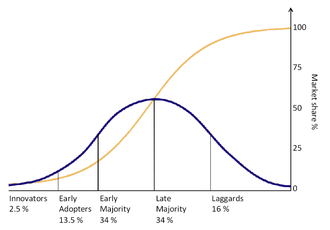
Everett Rogers published the Diffusion of Innovations in 1962, which clarified how people respond to change and new products.

Companies developed systems for launching innovations and building customer response. The film industry relied on critics to help sell films to audiences. Company web sites included reviews and customer comments. An expert system helped the flow of information and opinions to steer consumers in the desired direction.

What happened?

Amazon and eBay developed systems to include customer reviews on their sites. Consumers became accustomed to giving and receiving feedback from non experts about products and services. Company stooges were relatively easy to spot and ignore in making purchase decisions. These initiatives spawned a range of sites that included consumer reviews and feedback.

What happened next?

Other sites included a forum or discussion boards. Single issue fora focussed discussion around specific products and services. Other web sites included discussion boards about a range of topics and people had space to exchange views on a variety of consumer experiences. Regular visitors to these sites tended to ask fellow members for tips rather than turning to company websites.

What else happened?

Youtube hosted videos that showed how products worked. Some were made by the manufacturers, others by happy or dissatisfied users. Organisations and individuals began to show instruction films on how to do a range of things, including converting Youtube videos to audio files. Some were spoof reviews.


Peer to peer networking increased and companies were viewed as one element of the range of information sources available. Consumers might visit shops or websites to view the product, but looked around for the most competitive price online.

How did organisations respond?

Companies participated in discussion boards in 2 ways: 1) Staff provided helpful information and responded to feedback in positive and constructive ways, 2) Companies took web site hosts to court for publishing inaccurate or defamatory content. Some sites are now more cautious about content provided by consumers in contentious areas. Word gets round about the second tactic and does not boost sales.

Recently I emailed Apple about a problem with their product, which seemed to contravene consumer legislation on description of goods. They fobbed me off by directing me to tech support. I wrote to the Chief Executive (based in the USA) and the UK customer services manager was on the phone to me within a few days. She told me this was the first time she had heard a complaint about this particular problem. I pointed out that people had been discussing the issue for the last 4 years on their own web site fora.

If you don't use your own resources for listening to the customer, then they'll go elsewhere. If you don't or won't provide a solution to their problem, they'll find someone else who will.

Pubs may be closing every week in the UK, but people are finding virtual bars and cafes to gather, build relationships and exchange ideas about products and services. Even government experts no longer dominate:


The late majority and laggards may still respond to conventional systems, but the other 50% of the population comprising innovators, early adopters and early majority have voted with their feet and fingertips.

Russell Ackoff describes the evolution of companies from organisms to communities, in which people below elect their leaders. Perhaps the marketplace is evolving from distinct demographic strata into communities that are proactive and share ideas across demographic boundaries.


Customer relationship management (CRM) has become increasingly complex as customers don't necessarily gravitate to a company's website for information or to complain about their products.

Seller beware!

Friday, 18 February 2011

It's NOT the money

In the West we've slipped into believing that all change requires extra money to fund it. Eric Pickles begs to differ.

Ten years ago young Brazilian film maker told me he had made 6 films already and that students at the National Film and Television School in the UK seemed to think they needed £25,000 to make a film. He made his first work by offering a friend with a cine camera a bottle of vodkha for the use of the equipment. "In Brazil we are accustomed to bureaucratic restriction and meagre resources, so we learn to duck and dive."

The head of a tiny community association operating out of a portakabin with one paid member of staff found ways of dealing with bureaucracy imposed by funders and monitors. He asked an IT friend to design some software to read barcodes on the association's membership cards. Each time they ran an event, they were able to swipe the membership cards and generate the required statistics for the local authority as the gathering ended. Other community groups engaged volunteers to deal with the paperwork in assembling demographics to meet the local Equality Unit's specifications, but this organisation had automated the process in a low cost way.

I've coached professionals who tell me that laborious procedures, irritating and costly to the customer, can never be changed for safety reasons, or because supervisors will resist the change "That's the way we've always done it." When I ask them to consider the purpose of the exercise, it becomes easier for them to make changes and explain them to staff. For example, the NHS recalls people for a number of appointments to check on progress (such as fractures and breakthrough bleeding on skin in elderly people's legs.) Changing the system by telling the patient: 'Come back in X weeks time for your final appointment, but if ANYTHING happens to worry you in between, come straight back', reduces the number of appointments and improves patient satisfaction.

Some organisations undertake customer surveys and employee suggestion schemes, but often fail to engage people. Cynics may believe that any effort put into participating may well be put into a set of amalgamated graphics for a Board meeting rather than leading to any meaningful change.

One of my favourite examples of a successful approach is featured in Factor Four: Doubling Wealth & Halving Resource Use by Weizsacker, Lovins & Lovins. It comes from Dow Chemicals and Ken Nelson, a canny engineer, who devised a self funding scheme to save energy, reduce waste by organising a contest in his division. No managers were allowed to participate and submissions were peer reviewed. The most promising and profitable ideas were implemented. The figures are startling. In the 10th year of the contest (after 700 projects), the 109 winning projects averaged 305% ROI and in 1993 140 projects averaged 298% ROI with savings of $37 millions and more.

'The scheme involved no management thory or fads, but a practical shop floor process that translated volunteer ingenuity into saved money.'

The only reward staff received for participation was the satisfaction of doing something for themselves without management interference and a sense of tangible achievement. Sadly Dow chemicals dropped the scheme when Ken Nelson left.

The Rocky Mountain Institute has a long history of standing back and considering purpose instead of continuing to do more of the same.

Dedicated Follower of Fashion

Followers of management fads tend to focus on the process without being clear about the purpose and goal. Quality systems often led to the destruction of Norwegian pine forests in paper processing. Employees groan under the weight of procedures, without experiencing the benefit of the scheme.


In contrast, leaders who are clear about their purpose and with a vision of what a management tool can achieve are able to communicate this and engage colleagues in creating a system that is straightforward and brings tangible benefits. One surprise for me as a consultant is the number of managers I've met near to retirement who don't want to leave the job because a new leader has motivated them to implement a quality system and given them a renewed sense of having worthwhile career. The system is integrated smoothly in daily work, boosting ownership of process and results and empowering team members. Quality is then 'part of what we do', rather than a fashionable status symbol that is tossed out as soon as a new fad is adopted.

Once a management tool has been adopted and produced results, the biggest challenge is to maintain momentum and prevent it from fading out. Some of the most forward thinking companies I've worked with suffer from this problem, as they adopt new approaches and find it tough to maintain existing ones. The more the approach is integrated into daily procedures and becomes the default way of operating, the more likely it is to survive.

Management fads are not inherently flawed. Following the herd without a clear rationale for adopting an approach is likely to end badly. Failing to communicate clearly and motivate the team to embrace the approach to make it their own is the best way to ensure a management fad collapses and creates resentment amongst staff. Clarify the purpose and goal, simplifying the process to fit and success is possible.

Here's one view on the role of leaders:

Friday, 28 January 2011

Wicked oil (3)

How do Rittel's criteria link to the Wicked oil problem?

10 The planner has no right to be wrong

The oil company has no right to be wrong (around the USA)
During the Gulf of Mexico incident, President Obama spoke critically of BP's actions and announced that they would be forced to contribute substantial funds to clean up the area and compensate those affected directly and directly by the oil spill.

9 The existence of a discrepancy representing a wicked problem can be explained in numerous ways. The choice of explanation determines the nature of the problem's resolution

The discrepancy between environmentally sound supply and demand was explained by excess consumption and reliance on one energy source
What is less often publicised are President Obama's firm statements about the context of the event. He suggested that it highlighted America's dependence on oil supplies and the need to reduce consumption and consider alternative sources of energy. A new energy policy was proposed, but had a lukewarm reception.

8 Every wicked problem can be considered to be a symptom of another problem

High petrol prices are a symptom of supply problems, exploration costs, environmental protection costs, increasing consumption, unregulated commodity market speculation, population growth, greed, waste, government taxes............

7 Every wicked problem is essentially unique

At first glance the oil crisis can be compared to the global water crisis. There is NO substitute for water in the human body or agriculture, so we cannot explore alternative technology to flush kidneys, transport blood products round the body or enable plants to grow.

6 Wicked problems do not have an enumerable (or an exhaustively describable) set of potential solutions, nor is there a well-described set of permissible operations that might be incorporated into the plan

There are no Queensberry Rules for oil production, distribution and consumption. Even FIFA has problems applying their set of rules for the conduct of the World Cup. Sepp Blatter was attacked in South Africa for banning camera technology in deciding disputed decisions by linesmen and referees.

5 Every solution to a wicked problem is a "one shot operation"; because there is no opportunity to learn by trial-and-error, every attempt counts significantly

When Russia or the US drill for oil in the Artic, there is no prior experience to indicate the consequences for the environment. Putin can't replace the ice cap if the unintended consequences are disastrous.

4 There is no immediate and no ultimate test of a solution to a wicked problem

How do we know that there is enough oil in reserve for world consumption and that it can be extracted without cost to lives and environment? Is there an oil x-ray/thermometer/infallible algorithm? Nope.

3 Solutions to wicked problems are not true-or-false, but good-or-bad

A team of designers set out to design a new fuel efficient car. Firstly they discovered that traditional ways led them to trip over each other in accommodating for different systems. Secondly, when they all
collaborated over a blank sheet of paper, they devised a small car that could drive from West to East coast USA on one tank of petrol. For Western populations, that have embraced the gas guzzling SUV, I imagine this would be tough to accept. For Western politicians perhaps war is more acceptable than risky off shore oil exploration.


2 Wicked problems have no stopping rule

We'll need energy until the planet/the species dies. Oil has many uses beyond fuel and those applications will require substitutes, if possible. Our oil problem may be eclipsed when another energy source becomes the dominant commodity.

1 There is no definitive formulation of a wicked problem

We started with: How do we cut petrol prices? This simple question is inextricably linked to a mess of problems, symptoms and proposed solutions. In the UK we are criticised for squandering our oil resources (compared with other countries such as Norway) Scotland is campaigning for independence from the UK, in part so that remaining oil resources benefit Scotland rather than subsidising SE England. There is no consensus on oil prices and their cause:


So what?

Yep this is a wicked problem. We don't walk away and say it's impossible to tackle. Oil exploration companies are working to find and extract sources of oil around the globe. Politicians are balancing the need for tax income to strengthen the economy, the importance of encouraging fuel saving and tax payer resistance to further demands on their money.

Rittel and Webber remind us that wicked problems can be exhausting and frustrating. We need support in tackling them. Realistically our actions may have limited impact, if we have little power and no appetite to jeopardise our job. Krackhardt and Hanson can help amplify the impact of our interventions if we learn to build trust and support informally.

We can start by recognising that a sub-set of the wicked terrain can be tackled and may be phrased as a more Tame and manageable problem. How can we maintain stable oil prices? Seems to be the UK government's problem statement when planning specific tax/subsidy devices. How can we maintain oil supply for the forseeable future? seems to be Russia & BP's problem statement behind the decision to prospect for oil in the Arctic.

Thursday, 20 January 2011

Green Wash

This week Steve Jobs announced he is taking a break as Apple CEO for health reasons. News stories have criticised the company for its environmental record:

'Apple isn't as transparent as it could be when it comes to the effects its suppliers have on the environment and worker safety, according to a Chinese environmental group. The Institute of Public & Environmental Affairs (IPE) published a report (Chinese-language PDF) on Thursday ranking Apple and 28 other companies when it comes to taking responsibility for supplier conduct, with Apple coming in dead last on the list.'

'An Apple spokeswoman declined to comment on the report or its contents, but said: “Apple is committed to ensuring the highest standards of social responsibility throughout our supply chain. Apple requires suppliers to commit to our comprehensive Supplier Code of Conduct as a condition of their contract with us. We drive compliance with the Code through a rigorous monitoring program, including factory audits, corrective action plans, and verification measures.” '

Large companies are criticised for their environmental record, their use of sweatshop labour to produce cheap goods and boost profit margins. Since the financial crisis of 2008 there is increasing negative publicity about firms that outsource jobs overseas destroying Western communities in the process. Equity finance specialists that buy established brands but set up a post office box HQ in Lichtenstein (thus avoiding tax) are also under scrutiny.

Michael Porter is famous for his work on strategy and value chains. He now argues that global competitiveness involves creating shared value. This means taking corporate social responsibility into the core of the business, rather than making donations to charity or using biodegradable plastic bags. He claims that this type of cosmetic gesture won't work anymore. He doesn't believe that governments can drive changes in consumer behaviour to improve health, for example, but that corporations should take this on, because they have sophisticated marketing tools. Part of his argument is broadcast in the following video and more recent comments (linked to healthy consumption) have been aired on BBC radio 4.

'I believe that businesses acting as businesses, not as charitable givers, are arguably the most powerful force for addressing many of the pressing issues of society. We've got to do things in running our core businesses that maximise the positive benefits for the community and for society. And guess what... many of those things are going to advance the core agenda of the firm.'


Bloggers and Wikileaks may be part of the groundswell that is having a significant impact on politicians, companies and academics like Michael Porter.

I am sceptical about the impact of his ideas beyond transferring the 'healthy eating' drive from government to corporations.