I like to present clients, students and blog readers with simple, memorable ideas. I make this choice, not because I think these people are stupid, but to help those interested in the subject, who lead busy lives.
Typically in problem solving I tend to use a knocked down version of the Buffalo Group creative problem solving method. Instead of 6 phases, I work with 3 + 1. Depending on the circumstances I may or may not make the method explicit. People don't always want or need to see and understand the workings of the internal combustion engine to get from A to B in a car.
When I make the method explicit, I often use the analogy of human sexual relations to clarify the stages. CPS comprises the 3 diamonds: problem exploration, idea generation, implementation + monitoring and evaluation. In the metaphor this translates to: foreplay, intercourse, climax + 'How was it for you?'
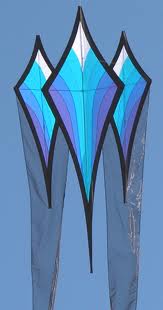
(Robert Brasington kites have full and knock down representations of the Buffalo Method. NLP fans may note that they facilitate movement in stuck problems by lifting people's focus out of the Kinaesthetic realm skywards.)
John Cleese gives an interesting lesson in sex education in the film ' The Meaning of Life', (shown here with Portugese sub titles). He states that the purpose of foreplay is to make intercourse easier:
During the practical demonstration he tells the class to 'take foreplay as read', because they covered it in a previous lesson. Unfortunately many of my clients and students wish to do the same, because they find the techniques fascinating and tend to think that creative problem solving happens when ideas are flowing. They haven't covered it in a previous session, so find that idea generation is more difficult or doesn't help resolve the problem.
Human seduction and sexual relations depend on the individual/s concerned. What works for one, may leave another cold. Erogenous zones for one person may be tickle centres for another and create distance between the partners. A problem may seem straightforward on the surface but comprise a number of interconnected parts. If there is a high degree of what Rittel/Mason & Mitroff describe as Wickedness, then work must be done to find a way in to tame it. There may be a number of different areas of a problem that can be tackled but some may lead to fruitful outcomes and others to blind alleys. If there is limited power or scope to influence a particular area then it may be better to move on to parts that are amenable to change.
Sometimes the problem is in the viewer. An issue can be looked at from different angles or reframed so that it becomes more manageable. Dr Abhay Bang reflected on an overwhelming problem and asked himself: 'Do I really need to solve all the problems, all the links in the chain of this cause of death?' I started to think: 'Where is the weakest link I can attack?' The problem owner may also be part of the problem and progress could be made by considering what he/she could do to change him/herself.
A problem well defined is a problem half solved is a useful way of considering the first phase of the method or foreplay.
This notion is sometimes greeted with a groan (much like the schoolboys' response when John Cleese threatens to set an exam.) This assumes that the method will take a long time and require lots of hard work (ie boring.)
It ain't necessarily so.
Sex isn't always the same in terms of quality, quantity or duration. Foreplay can be a long drawn out meal with lots of flirting and interaction or may take the form of a fierce argument between partners. Partners may not always reach a climax and solo sex is also possible. A look, a brief exchange and heightened attraction may do it, as Eban Page explains in his 'cocky and funny' dating system under the name David DeAngelo (aimed at nerdy guys who can't get a date.)
In creative problem solving problem exploration/definition can be done over time in a variety of conversations and contexts. It's possible to snatch little bits of time here and there and I've witnessed successful work done in corridor conversations or water cooler exchanges. Appropriate techniques can be introduced quietly without labelling them as anything special. People are pulled in by the energy and fun of tackling something in a different way, particularly if the problem is entrenched and stuck.
Counter intuitive techniques can be particularly effective in warming up colleagues to the idea of tackling something difficult. Steve Jobs believes people are inherently creative, but need opportunity and tools to unleash this. 'Not tonight, Josephine, I have a headache' can be challenged in various ways. When we open to the possibility that our colleagues might be more creative than we think, we can run creative problem solving processes on the sly and see what emerges. Something as simple as a metaphor can stimulate thinking that is unconstrained by the heavy weight of the real problem - 'What would Homer do?'. A simple reverse brainstorm can also clear a log jam in thinking: 'How can we make this problem catastrophic?'
The method can be run through fast, revisiting one or more phases later for further iterations.

Heinz latched on to the idea of rapid problem solving and snatching opportunities where we can in the famous soup commercial, commenting on male stamina:
'Ready in two minutes'
Showing posts with label Rittel. Show all posts
Monday, 25 April 2011
Fancy a quickie?
Labels:
creative problem solving,
creative problem solving techniques,
metaphor,
method,
reflection,
Rittel
Friday, 28 January 2011
Wicked oil (3)
How do Rittel's criteria link to the Wicked oil problem?
10 The planner has no right to be wrong
The oil company has no right to be wrong (around the USA)
During the Gulf of Mexico incident, President Obama spoke critically of BP's actions and announced that they would be forced to contribute substantial funds to clean up the area and compensate those affected directly and directly by the oil spill.
9 The existence of a discrepancy representing a wicked problem can be explained in numerous ways. The choice of explanation determines the nature of the problem's resolution
The discrepancy between environmentally sound supply and demand was explained by excess consumption and reliance on one energy source
What is less often publicised are President Obama's firm statements about the context of the event. He suggested that it highlighted America's dependence on oil supplies and the need to reduce consumption and consider alternative sources of energy. A new energy policy was proposed, but had a lukewarm reception.
8 Every wicked problem can be considered to be a symptom of another problem
High petrol prices are a symptom of supply problems, exploration costs, environmental protection costs, increasing consumption, unregulated commodity market speculation, population growth, greed, waste, government taxes............
7 Every wicked problem is essentially unique
At first glance the oil crisis can be compared to the global water crisis. There is NO substitute for water in the human body or agriculture, so we cannot explore alternative technology to flush kidneys, transport blood products round the body or enable plants to grow.
6 Wicked problems do not have an enumerable (or an exhaustively describable) set of potential solutions, nor is there a well-described set of permissible operations that might be incorporated into the plan
There are no Queensberry Rules for oil production, distribution and consumption. Even FIFA has problems applying their set of rules for the conduct of the World Cup. Sepp Blatter was attacked in South Africa for banning camera technology in deciding disputed decisions by linesmen and referees.
5 Every solution to a wicked problem is a "one shot operation"; because there is no opportunity to learn by trial-and-error, every attempt counts significantly
When Russia or the US drill for oil in the Artic, there is no prior experience to indicate the consequences for the environment. Putin can't replace the ice cap if the unintended consequences are disastrous.
4 There is no immediate and no ultimate test of a solution to a wicked problem
How do we know that there is enough oil in reserve for world consumption and that it can be extracted without cost to lives and environment? Is there an oil x-ray/thermometer/infallible algorithm? Nope.
3 Solutions to wicked problems are not true-or-false, but good-or-bad
A team of designers set out to design a new fuel efficient car. Firstly they discovered that traditional ways led them to trip over each other in accommodating for different systems. Secondly, when they all
collaborated over a blank sheet of paper, they devised a small car that could drive from West to East coast USA on one tank of petrol. For Western populations, that have embraced the gas guzzling SUV, I imagine this would be tough to accept. For Western politicians perhaps war is more acceptable than risky off shore oil exploration.
2 Wicked problems have no stopping rule
We'll need energy until the planet/the species dies. Oil has many uses beyond fuel and those applications will require substitutes, if possible. Our oil problem may be eclipsed when another energy source becomes the dominant commodity.
1 There is no definitive formulation of a wicked problem
We started with: How do we cut petrol prices? This simple question is inextricably linked to a mess of problems, symptoms and proposed solutions. In the UK we are criticised for squandering our oil resources (compared with other countries such as Norway) Scotland is campaigning for independence from the UK, in part so that remaining oil resources benefit Scotland rather than subsidising SE England. There is no consensus on oil prices and their cause:
So what?
Yep this is a wicked problem. We don't walk away and say it's impossible to tackle. Oil exploration companies are working to find and extract sources of oil around the globe. Politicians are balancing the need for tax income to strengthen the economy, the importance of encouraging fuel saving and tax payer resistance to further demands on their money.
Rittel and Webber remind us that wicked problems can be exhausting and frustrating. We need support in tackling them. Realistically our actions may have limited impact, if we have little power and no appetite to jeopardise our job. Krackhardt and Hanson can help amplify the impact of our interventions if we learn to build trust and support informally.
We can start by recognising that a sub-set of the wicked terrain can be tackled and may be phrased as a more Tame and manageable problem. How can we maintain stable oil prices? Seems to be the UK government's problem statement when planning specific tax/subsidy devices. How can we maintain oil supply for the forseeable future? seems to be Russia & BP's problem statement behind the decision to prospect for oil in the Arctic.
Labels:
creative problem solving,
Factor Four,
informal networks,
innovation,
Krackhardt and Hanson,
Rittel,
Wicked
Thursday, 27 January 2011
Wicked oil (2)
Horst Rittel and Melvin Webber developed the concept of wicked problems in relation to planning issues. I've done work with planners and have experienced their frequent 'yes, but' responses during Idea Generation phases of creative problem solving, so I recognise that their field is constrained by many competing factors. Rittel and Webber identified the challenge of context in dealing with social problems, which makes these wicked problems so difficult to tackle.
Rittel and Webber identified at least 10 distinguishing properties of wicked problems summarised in the following extract from their 1973 paper:
1 There is no definitive formulation of a wicked problem
The information needed to understand the problem depends upon one's idea for solving it. In order to describe a wicked problem in sufficient detail, one has to develop an exhaustive inventory of all conceivable solutions ahead of time. The reason is that every question asking for additional information depends upon the understanding of the problem - and its resolution - at that time.
2 Wicked problems have no stopping rule
In solving a chess problem or a mathematical equation, the problem-solver knows when he has done his job. There are criteria that tell when the or a solution has been found.
Not so with planning problems.
The planner terminates work on a wicked problem, not for reasons inherent in the "logic" of the problem. He stops for considerations external to the problem: he runs out of time, or money, or patience.
3 Solutions to wicked problems are not true-or-false, but good-or-bad
There are conventionalised criteria for objectively deciding whether the offered solution to an equation or proposed formula of a chemical compound is correct or false.
For wicked problems, there are no true or false answers. Normally, many parties are equally equipped, interested, and/or entitled to judge the solutions, although none has the power to set formal decision rules to determine correctness. Their judgments are likely to differ widely to accord with their group or personal interests, their special value-sets, and their ideological predilections. Their assessments of proposed solutions are expressed as "good" or "bad" or, more likely, as "better or worse" or "satisfying" or "good enough".
4 There is no immediate and no ultimate test of a solution to a wicked problem
For tame-problems one can determine on the spot how good a solution-attempt has been.
With wicked problems, any solution, after being implemented, will generate waves of consequences over an extended-virtually an unbounded- period of time. Moreover, the next day's consequences of the solution may yield utterly undesirable repercussions which outweigh the intended advantages or the advantages accomplished hitherto. In such cases, one would have been better off if the plan had never been carried out.
5 Every solution to a wicked problem is a "one-shot operation"; because there is no opportunity to learn by trial-and-error, every attempt counts significantly
In the sciences and in fields like mathematics, chess, puzzle solving or mechanical engineering design, the problem solver can try various runs without penalty. A lost chess game is seldom consequential for other chess games or for non-chess-players.
With wicked planning problems, however, every implemented solution is consequential. It leaves "traces" that cannot be undone. One cannot build a freeway to see how it works, and then easily correct it after unsatisfactory performance. Large public-works are effectively irreversible, and the consequences they generate have long half-lives.
Whenever actions are effectively irreversible and whenever the half lives of the consequences are long, every trial counts. And every attempt to reverse a decisions or to correct for the undesired consequences poses another set of wicked problems, which are in turn subject to the same dilemmas.'
[Town planners in Glasgow wanted to solve the problems of slums by building a brave new world of tower blocks called the Gorbals. The break up of communities contributed to stress and isolation. 38 years later the last 2 tower blocks were demolished in 2008]
'6 Wicked problems do not have an enumerable (or an exhaustively describable) set of potential solutions, nor is there a well-described set of permissible operations that may be incorporated into the plan
There are no criteria which enable one to prove that all solutions to a wicked problem have been identified and considered.
Normally, in the pursuit of a wicked planning problem, a host of potential solutions arises; and another host is never thought up. And it is, of course, a matter of judgment which of these solutions should be pursued and implemented.
Chess has a finite set of rules, accounting for all situations that can occur. In mathematics, the tool chest of operations is also explicit; so, too, although less rigourously, in chemistry.
7 Every wicked problem is essentially unique
Despite seeming similarities among wicked problems, one can never be certain that the particulars of a problem do not override its commonalities with other problems already dealt with.
The conditions in a city constructing a subway may look similar to conditions in San Francisco, say; but planners would be ill-advised to transfer the San Francisco solutions directly.
8 Every wicked problem can be considered to be a symptom of another problem
Problems can be described as discrepancies between the state of affairs as it is and the state as it ought to be. The process of resolving the problem starts with the search for causal explanation of the discrepancy. Removal of that cause poses another problem of which the original problem is a "symptom". In turn, it can be considered the symptom of still another, "higher level" problem. Thus "crime in the streets" can be considered as a symptom of general moral decay, or permissiveness, or deficient opportunity, or wealth, or poverty, or whatever causal explanation you happen to like best. The level at which a problem is settled depends upon the self-confidence of the analyst and cannot be decided on logical grounds. There is nothing like a natrual level of a wicked problem.
9 The existence of a discrepancy representing a wicked problem can be explained in numerous ways. The choice of explanation determines the nature of the problem's resolution
"Crime in the streets" can be explained by not enough police, by too many criminals, by inadequate laws, too many police, cultural deprivation, deficient opportunity, too many guns, phrenologic aberrations etc. Each of these offers a direction for attacking crime in the streets. Which one is right? There is no rule or procedure to determine the "correct" explanation or combination of them. The reason is that in dealing with wicked problems there are several more ways of refuting a hypothesis than there are permissible in the sciences.
The choice of explanation is arbitrary in the logical sense. In actuality, attitudinal criteria guide the choice. People choose those explanations which are most plausbile to them.
10 The planner has no right to be wrong
As Karl Popper argues, it is a principle of science that solutions to problems are only hypotheses offered for refutation. This habit is based on the insight that there are no proofs to hypotheses, only potential refutations. The more a hypothesis withstands numerous attempts at refutation, the better its "corroboration" is considered to be. Consequently, the scientific community does not blame its members for postulation hypotheses that are later refuted.
In the world of planning and wicked problems no such immunity is tolerated. Here the aim is not to find the truth, but to improve some characteristics of the world where people live. Planners are liable for the consequences of the actions they generate; the effects can matter a great deal to those people that are touched by those actions.'
[In this case, from Arizona, the engineer gets the blame.]
Labels:
creative problem solving,
Problem type,
Rittel,
Tame,
Wicked
Wicked oil (1)
In the last week 4 friends have sent me an email outlining a campaign to force oil companies to lower petrol prices. The suggested solution is to buy from supermarkets to force oil companies to compete for trade.
I was surprised at the idea. The Big Four supermarkets already have a dominant position in high street retail and I'm not keen to contribute further to this trend.
Here's a different view from Down Under:
The assumption in the email that the problem: How to reduce petrol prices? is simple to solve or Tame in the terminology of Rittel and Webber. I'm not so sure.
Ever since oil was discovered at Spindletop, Texas in 1901, sources of easily refined crude oil have been mined extensively. On shore sources are diminishing and 2010 saw major controversy over an explosion during offshore drilling by BP in the Gulf of Mexico. The site of the rig indicates that companies are having to explore areas with increasingly difficult access. People in the USA are accustomed to cheap petrol prices and seem to have trouble connecting the rapid consumption of a finite resource with the need for ever riskier exploration methods. The US government punished BP for the consequences of the explosion, but is not pleased with the news that BP has done a deal with Russia to explore oil in the Arctic. This type of exploration is not cheap and requires new and experimental technology. Tesco doesn't do oil exploration. They sell what others make at a price the market can bear.
The underlying problem statements for the US public seem to be:
How do we maintain an unending and increasing supply of petrol? How do we keep petrol prices low? How do we prevent loss of life and damage to the environment in the process?
Rittel and Webber would describe this as a Wicked problem.
'..we are calling them "wicked" not because these properties themselves are ethically deplorable. We use the term "wicked" in a meaning akin to "malignant" (in contrast to "benign") or "vicious" (like a circle) or "tricky" (like a leprechaun) or "aggressive" (like a lion, in contrast to the docility of a lamb.)'
Several commentators, notably Matthew Simmons (Twilight in the Desert: The Coming Saudi Oil Shock and the World Economy), have alerted the world to the unreliability of Middle Eastern oil reserves and the idea that Peak Oil has been reached - ie that the major sources of oil are now in decline.
Here's a simple graphical illustration of this point. The decline probably doesn't accelerate this quickly, but if we factor Peak Oil in, we're more likely to ride the wave.
It has been suggested that the original catalyst for the invasion of Iraq was the threat to oil price stability by Saddam Hussein. Some commentators assert that Iran became a potential target for similar reasons.
Dominance of oil and gas supplies enables countries to exert control over neighbouring territories. Ukraine developed a degree of independence until Russia brought the country to heel by stopping all supplies and enforcing prices beneficial to them.
The BRIC countries (Brazil, Russia, India and China) are developing at a formidable rate with an increasing demand for commodities including oil. In the West we have shifted from one car per household to one car per adult in many areas. Developing countries, such as China, have shifted from the bicycle to the car.
The increased use of motor vehicles is thought to be a major contributor to diminishing air quality and greenhouse gases. GHGs are linked to climate change.
Some people argue that cars should be run on biofuels. One suggestion is to use oil from crops such as rapeseed. We have an increasing world population, rising standards of living in developing countries and a greater demand for food. Crops have been poor in the last couple of years because of global weather events, highlighting the vulnerability and unpredictability of food supply. Biofuel crops compete for land with food crops.
We import much of our food in the UK. Supermarkets source a ready, cheap supply of fresh products from around the globe so that we can buy all year rather than consuming seasonal produce. Imports depend on oil supply for transport. In the UK our hard pressed farming sector struggles to meet costs from prices paid by wholesalers (including supermarkets). Some make more money from selling farmland to property developers, reducing the supply of land for food or biomass crops.
My suggested list of problem statements now includes:
How do we continue to run our cars? How do we maintain clean air? How do we reduce our impact on climate change? How do we maintain access to affordable, dependable supplies of food? How do we house our population to an acceptable standard?
My students sometimes struggle to grasp the notion of a wicked problem. I use the analogy of a waterbed. If you press down in one area, another part pops up. There is no neat and easy way to solve this and every solution may throw up unintended consequences.
Labels:
corporate social responsibility,
creative problem solving,
environment,
Problem type,
Rittel,
Tame,
Wicked
Subscribe to:
Posts (Atom)

