Showing posts with label market pull. Show all posts

Wednesday, 13 April 2011

'Me-too' products

Wine developed in different ways around the world. France was proud of terroir and the notion that the region and local conditions affected the character of the wine. The New World focussed on grape varieties and interesting blends.

Globalisation led to shifts in production. Australians parachuted in to France to help modernise the wine industry. Countries creatively swiped ideas from others on how to produce better wines. Technology drove many changes. The increasing power of supermarkets in the UK led to buyers advising producers on blends that would suit UK tastes, and with a large customer base, their arguments were persuasive.

Some French wine experts moved to London, claiming that British people were more adventurous in their tastes in wine than the French.

One of these was Master of Wine Isabelle Legeron. She argues that globalisation has led to a homogenised market, which has become saturated, so that wine sales are falling. She is particularly critical of the focus on technology and additives to fix poor wines, rather than attention paid to the quality of vines and grapes. Isabelle is an advocate of natural wines:


I met Isabelle at a screening of a documentary on Georgian kvevri wines, which are made in large earthenware jars sunk in the ground.
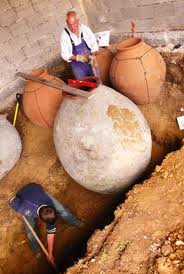

The character of these wines is very different from conventional bottles. We drank golden wine, which was white wine fermented on the skins. Another producer offered glasses of a stunning deep red wine poured from a decanter. This tasted of fresh blackberries or elderberries. The champion of this particular red wine told me it was being added to a blend to suit European tastes before he rescued it for sale as a single wine.


Georgians believe they were the first in the world to make wine and maintain traditions going back a thousand years in producing unadulterated, natural wines. Some Georgians are ashamed of Isabelle's tv programme, because it shows old delapidated farm houses and peasants with few teeth. They would prefer to focus on the modern side of the country, thinking that this would help export more wine and attract tourists. Sadly this would lead to more generic wine entering the market chasing prices and profit margins to the bottom.

A source of innovation in Europe is dissatisfaction with the status quo in food and drink. In 1986 Carlo Petrini founded the Slow Food movement in Italy to promote traditional methods of growing and producing food suitable to the local environment and regional tastes.

Georgian kvevri wine fits easily into this movement, valuing flavour and naturalness over efficient, high tech production, which leads to globally identical food and drink. Georgia still has a large number of grape varieties unknown anywhere else in the world. Unfortunately kvevri makers are growing old and young people are not interested in learning the skill of crafting these large clay pots.

Peters and Waterman would tell Georgians to stick to the knitting and not mess about trying to copy wine styles and production methods from other parts of the world.

An NLP precept often quoted is 'If something isn't working, do something different.' This leaves out the other half of the quote (from Milton Erickson) 'If something is working, do more of it.'

Isabelle is determined not to allow traditional kvevri wines to disappear in Georgia just when Westerners are learning to love them.

Here is the trailer for her programme:


Update

In July 2011 there was a 3 day symposium in Tbilisi on kvevri wine making.

Wednesday, 30 March 2011

Altruism meets Everest

Marc Koska invented something to make an impact on the rapid spread of HIV and AIDS through re-used syringes:

'My motivation was half humanitarian and half wanting to see whether I could do it. I never set my sights on a Ferrari and I never wanted to be Joan of Arc; it was somewhere between the two.'

He read an article in 1984 about the problem and spent 27 years trying to invent and bring to market a device that could change the growing loss of life in the developing world. Marc devised a single use syringe.


Here's a man with A levels, who spent part of his time as a beach bum and then took casual jobs to keep himself going. The process was tough and there's little margin in selling syringes, so it was difficult to market the product initially.

'I think our product has won out because we didn’t set out to design the best syringe in the world – I designed it to be adequate and very easy to manufacture.'

Marc decided on 3 design pillars for the new syringe:

1 Make it on existing machines (with the same plastic)
2 Sell it for the same low price
3 Ensure it's used in the same way as existing syringes

His TED lecture includes examples of children recycling and selling old syringes or playing with syrings with traces of blood in them:


Who inspires Marc to keep going?

'I could have given up a number of times. I was offered quite a lot of money for the project before we even sold any, and I said "no" because it was likely to be killed at that point. The only person is the one that you look at in the mirror.'

This story highlights 2 distinct issues in developing innovations.

1 How to devise, manufacture and sell something the market needs and can use at a price consumers are willing to pay

2 How to ensure that the product or service is adopted, so that it becomes ubiquitous

Marc is aware that safe syringes will only be used when consumers demand them as standard. This is difficult in developing countries, where patients may not challenge doctors, who have high status. He noticed that his syringes were being used in one part of a Ugandan hospital, but conventional syringes were re-used in another part.

He founded SafePoint Trust to spread information to consumers about basic healthcare problems and to encourage the adoption of single use syringes everywhere.

In 2008 'After the gruelling five-day media blitz in the country in November, Mr Koska said he was able to return for a meeting with Indian health minister Dr Anbumani Ramadoss in December and leave with the guarantee autodisable syringes would be used in all public hospitals and clinics starting in April this year.'

There is no let up. The fight for basic healthcare in developing countries is tough and takes great persistence.

"When the minister said 'yes' I went outside and cried for five minutes."

Student design

Min-Kyu Choi won a prize for re-inventing the electric plug. This video shows how: