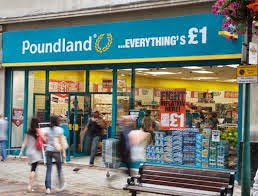
Poundland shopping was my guilty secret. I thought discount shops ripped off manufacturers. A radio documentary put me right.
One of the founders, Steve Smith, was part of a family that ran a stall in Bilston market. His father was an engineering draughtsman, but found that he made more money from selling specialist pens to colleagues.
Steve learnt from market stall customers what they wanted and how much they wished to pay (as well as how much and how often they'd buy). He'd go away and source the goods, negotiating a price that would give them a profit on the sale.
On the stall was a cardboard box labelled 'everything here for 10 pence'. The family discovered they made more money from the discount box than the rest of the stall. That contributed to the idea of a discount chain of stalls.
Steve and his co-founder sourced no-name goods. They took over £13000 on the first day of trading. They worked hard on landing branded suppliers. Once they had one, WD40, the rest followed. Steve aimed to look after customers and add value to goods sold. He encouraged managers to take a turn on the till, to ensure they developed the habit of listening to customers.
What is the attraction to manufacturers?
Poundland strikes a hard bargain once a year. Once the price is agreed, the only time that manufacturers hear from a discount stores is when they want to order more goods.
The big 4 supermarkets are in constant contact, demanding surcharges for prime positioning of product on shelves, discount promotions and other arrangements that make it difficult to estimate cashflow as well as putting pressure on staff at short notice. I've worked with managers from a major UK manufacturer and know the stress caused by powerful supermarkets that borders on bullying.
What is the attraction to customers?
Discount stores such as Poundland, Lidl and Aldi, focus on a simple and transparent formula. Their goods are of good quality, but sold at a reasonable and consistent price. The big 4 supermarkets use a mixture of deals: BOGOF (buy one, get one free) and loyalty cards with points redeemable on specific goods, which aim to entice customers to buy larger quantities. Tesco attracts criticism for convoluted pricing that conceals poor deals.
Why shop at a supermarket for the same basic goods, when you can buy them for consistently cheaper prices at a discount store?
People reject manipulation and tricks that leave them poorer. Tesco is losing market share to the discounters.
Low cost airlines also meet customer resistance because of the use of dynamic pricing. This enables the companies to drive up the price for repeat customers on the internet, while offering lower prices to new enquiries. Easyjet and Ryanair are no longer small airlines. Customers are less willing to tolerate substandard service for low prices. Retail outlets like Aldi have demonstrated how low prices can be coupled with high quality and raised the bar for all.
Showing posts with label core business. Show all posts
Friday, 19 September 2014
Pricing and Poundland
Saturday, 27 July 2013
Conduct unbecoming: Co-op Bank and Mr Wheatley
The Financial Conduct Authority, one of the organisations that replaced the UK's FSA, has now given advice to customers who fear they may lose their Co-op investments.
The FCA is there to regulate conduct in relation to financial products. It has the power to investigate organisations and individuals.
The head of the FCA, Martin Wheatley, has effectively told Co-op bank investors that they're on their own. They must wait and see what Co-op bank decides to do to salvage its financial stability. He claims that Co-op bonds were inherently risky, that this was disclosed at issue and that any future loss should be dealt with by referring to the customer's financial adviser (presumably to sue them for misselling).
Mark Taber, of the Co-op Bank Action Group, disagrees. He and a group of energetic researchers have gathered data, which he's used to present a coherent argument to contradict Mr Wheatley's assertions. Taber has also assembled links to documents supporting his defence of customers. Mark has also gathered press cutting from 1992 covering the PIBS, which further debunk Mr Wheatley's claims.
Taber concludes by pointing out that a 13% coupon was not exceptional in 1992, when Government gilts (rock solid secure investments) were issued with a 12% coupon and annuity rates were 13-14%. Perhaps Mr Wheatley is relying on a younger, gullible readership, who have never experienced rates above 10%.
'Perhaps some of you IFAs would like to present this research to Mr Wheatley and ask why he is telling people to sue you?'
Labels:
bank,
Co-op Bank,
core business,
corporate social responsibility,
customer service,
ethics,
Mark Taber
Thursday, 20 January 2011
Green Wash
This week Steve Jobs announced he is taking a break as Apple CEO for health reasons. News stories have criticised the company for its environmental record:
'Apple isn't as transparent as it could be when it comes to the effects its suppliers have on the environment and worker safety, according to a Chinese environmental group. The Institute of Public & Environmental Affairs (IPE) published a report (Chinese-language PDF) on Thursday ranking Apple and 28 other companies when it comes to taking responsibility for supplier conduct, with Apple coming in dead last on the list.'
'An Apple spokeswoman declined to comment on the report or its contents, but said: “Apple is committed to ensuring the highest standards of social responsibility throughout our supply chain. Apple requires suppliers to commit to our comprehensive Supplier Code of Conduct as a condition of their contract with us. We drive compliance with the Code through a rigorous monitoring program, including factory audits, corrective action plans, and verification measures.” '
Large companies are criticised for their environmental record, their use of sweatshop labour to produce cheap goods and boost profit margins. Since the financial crisis of 2008 there is increasing negative publicity about firms that outsource jobs overseas destroying Western communities in the process. Equity finance specialists that buy established brands but set up a post office box HQ in Lichtenstein (thus avoiding tax) are also under scrutiny.
Michael Porter is famous for his work on strategy and value chains. He now argues that global competitiveness involves creating shared value. This means taking corporate social responsibility into the core of the business, rather than making donations to charity or using biodegradable plastic bags. He claims that this type of cosmetic gesture won't work anymore. He doesn't believe that governments can drive changes in consumer behaviour to improve health, for example, but that corporations should take this on, because they have sophisticated marketing tools. Part of his argument is broadcast in the following video and more recent comments (linked to healthy consumption) have been aired on BBC radio 4.
'I believe that businesses acting as businesses, not as charitable givers, are arguably the most powerful force for addressing many of the pressing issues of society. We've got to do things in running our core businesses that maximise the positive benefits for the community and for society. And guess what... many of those things are going to advance the core agenda of the firm.'
Bloggers and Wikileaks may be part of the groundswell that is having a significant impact on politicians, companies and academics like Michael Porter.
I am sceptical about the impact of his ideas beyond transferring the 'healthy eating' drive from government to corporations.
Subscribe to:
Posts (Atom)


