Fitness trainers at the gym often profess to be experts on nutrition and weight loss. Here's an example of one leaflet circulated on the topic.
Metabolism and why diets don't work includes a paragraph on body fat percentage and ratio of fat to lean, but does not distinguish between visceral fat (surrounding the internal organis) and body fat (under the skin.) The first is the main indicator of potential problems with heart disease and poses a greater risk than the second.
Guidance focusses on calorie restriction and increased exercise (calories in/calories out). Anyone who has exercised on machines in gyms, that show calorie expenditure, know that much exercise expends far fewer calories than we consume in food. It makes no mention of the effects of different foods (irrespective of calories) and how some people lose weight even when injured and unable to exercise, by changing what they eat.
The section on understanding food labels includes some sensible advice:
'What else to look out for
• Foods that have lots of artificial ingredients such as artificial flavours, sweeteners,
colours, stabilisers and preservatives
• Foods that have a lot of fat, sugar and salt
• Foods that contain “trans fats” or “hydrogenated fats”
• Foods containing very few natural foods, or foods that have been altered: “modified”, “hydrogenated”, “reconstituted”, etc
• Watch out for ingredients that you do not recognise, if in doubt leave them on the shelf
• Foods that have no nutritional information - “takeaways”'
Slipped in the middle of the list is the warning against: 'Foods that have a lot of fat'
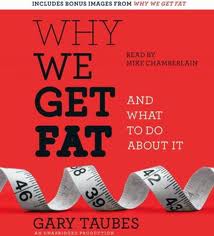
Gary Taubes has demonstrated that saturated fat is important for most people, except the few with conditions such as hyperlipidemia, in his books: 'Good fats, bad fats' and 'Why we get fat'. Saturated fat, such as coconut oil, can be useful in working with dementia.
He also challenges the received wisdom about weight loss and exercise, though many acknowledge its role in maintaining insulin sensitivity.
Doug McGuff has some interesting views on exercise and the relative effectiveness of different types on human metabolism:
Petro Dobromylskyj makes a strong case for the central role of insulin in fat gain.
Tom Naughton points out that intelligent people in the West seem incapable of distinguishing good from bad science and the use and abuse of statistics. His lecture helps to explode some of the myths peddled by 'weight loss experts' and gym staff.
Science for smart people:
PS
There's an interview at the end of Tom Naughton's lecture. He talks to an Ob Gyn, who wants to set the story straight about HRT and explain why one of Naughton's examples isn't so simple.
Questions: Who funds him and his research? What about links between HRT and breast cancer? Why should women take HRT anyway, when dietary and lifestyle changes can help them reduce and deal with natural signs of menopause?
Keep your brain switched on, when watching this segment.
In my previous post I seemed to suggest that, Giorgi Targamadze, the Opposition leader in the Georgian Parliament stands no chance of winning an election. I also seemed to imply that image is the only thing that matters.
I believe that changes in how we transmit, receive and process information have had a major impact on elections and democracy. Personality is now a bigger component than before in deciding the outcome of a ballot.
In the UK election campaigns have changed. People have little time or inclination to attend election meetings in local church halls (except to question their sitting MP about abuse of expenses). The population has increased and the logistics required to talk to the majority of people face to face are enormous. Politicians rely increasingly on radio, television and the internet to persuade voters. Membership of political parties has fallen and funding has dropped, reducing the resources available to campaign for an election.
People have severals decisions to make: Do I vote for party x or y? Do I bother to vote at all?
What do I vote for? Who do I vote for?
The choice is between various policies and parties (increasingly different individuals).
In the UK politial parties now cluster around the centre ground and there is much less radical difference between policies, but smaller differences in detail. Even the apparent major disagreements seems to converge after a time, such as the question of whether we need to tackle the deficit or not (the deficit deniers have conceded defeat). In the past there were firm allegiances to parties based on class and self identity. Some people continued to vote for the same party as their parents whatever happened, because they could not imagine crossing party and class lines. Margaret Thatcher contributed to a major shift in mindsets by shaping policy to meet the aspirations of working class people who wanted greater opportunity and material rewards.
Mass communication brings new ideas to the population very quickly. Increasingly the party in power seeks to colonise good ideas presented by the Opposition either by incorporating some of the detail in their own work or making a policy announcement that is very similar (even if it is never carried out). Opposition parties are therefore cautious about making too many proposals and providing detail, preferring instead to focus on criticising the government.
The voting public are presented with sound bites, MPs speaking 'on message' with a series of catch phrases designed to appeal to broad swathes of the population in marginal constituencies. This translates to tabloid style headlines rather than lengthy, reasoned discourse. It becomes increasingly difficult to determine exactly what each party and person proposes to do if they gain power. In the past the Party Manifesto was a document shaped at the annual party conference and a pledge for action at the election. It resembled an architect's model of a proposed building scheme. It now seems to be a draft submission equivalent to a few rough sketches made on the back of an envelope.
Politicians are very aware of public reaction to each appearance, speech and policy announcement. Online polls such as YouGov deliver fast feedback which shapes future decisions. Popular blogs are ferocious in holding MPs to account and surfacing embarrassing stories.
Some politicians try to set up staged encounters with members of the public to help them seem more in touch and appreciative of local efforts. Unfortunately this often backfires as human beings want to raise topics that affect them directly. Gordon Brown handled this encounter badly, but made the mistake of criticising the woman, not realising his microphone was still live:
Visual media tend to focus on personalities rather than parties. Politicians look to the USA for ways of appealing to voters and opted to stage a tv debate between the 3 main political leaders. The ability of individuals to seem convincing, to appear to have integrity and to speak directly to people (ie face the camera) and touch on issues of concern to the public made a difference in that election. Nick Clegg was more media savvy in dealing with tv and the proportion of votes for the Liberal Democrats rose. We now have a coalition government. TV debate and media appearances tend to favour Extravert Intuitors (in MBTI terms), who are more at ease talking to a group of people and communicating in broad terms. Gordon Brown, as an Introvert Sensor, is more comfortable talking one to one and dealing with detail. He is not effective speaking spontaneously, but needs time to formulate his thoughts. This doesn't play well with his audience.
Voters consider whether the individual seems to have the right attitude to the main issues of concern. The public assess the competence of each individual to lead the country, tackle tough economic problems and communicate with people at all levels. Voters wonder how far they can trust this person to carry out his/her promises.
Tony Blair was famous for delivering different speeches and ideas to different audiences (sometimes on the same day) and was accused of blowing in the wind rather than holding to a particular position and set of policies. Commentators also say that his speeches were based on a series of Powerpoint slides with 3 points per slide, which was all he could memorise. His heads of Strategy and Implementation would seed new vocabulary that signalled key changes in direction.
Unfortunately for politicians, they may change their stance and claim to have held this view since the beginning, but the internet provides evidence of hypocrisy (in this case Gordon Brown encouraged 'light touch regulation' for the City of London).
Georgian Opposition leader, Giorgi Targamadze, also seems to focus more on detail in his speeches and his audience may not see the wood for the trees in what he says. Voters may also wonder if he, as a former tv anchor, has the capacity to deal with harsh economic reality and the knock-on effect of the collapse of the important Russian market. He works hard to appeal to village women by linking his party to the Georgian Orthodox church. Some people in the city may have reservations about the consequences of linking politics and religion so firmly, particularly in view of some of the Patriarch's pronouncements that overtly attack the effects of government policy on homosexuality. This trend might not help Georgia's application to join the EU.
In the last few years I've had dealings with Barclays bank in the UK. Their model of staff development and promotion depends on moving staff around constantly and upgrading them accordingly. The idea seems to be to familiarise everyone with different aspects of the business. If you happen to enjoy dealing with the public and don't want to become a back office manager, then your pay may be restricted and your work not so highly valued, because you choose to stay where you are. I imagine that head office regard the few who choose to stick to a particular frontline job as 'barnacle' managers and think that they slow the ship in its progress.
Instead of training staff in detail, information is made available through a centralised database. This is fine in theory yet seems to ignore how human beings actually function. I know that some people read the manual from cover to cover and learn everything there is to understand about a machine or system. Many people ignore the manual until they need something specific, at which time they drill down through the information as far as they need to make something work. That's OK if you're running a computer, but not so great if a client has come to ask you about a specific product or wants to make a change in their account. If it takes half an hour to access the information and apply it satisfactorily, then you're likely to lose all credibility with the customer and try their patience to the limit.
At Barclays, while waiting to see a particular 'barnacle' manager, I observed many times the same pattern. The young movers and shakers would approach the older 'barnacle' who could explain what they needed in 5 minutes, rather than leaving them to struggle (in front of their customer) for half an hour. What I could see and head office couldn't was that the 'barnacle' was the lynchpin of the branch, ensuring that the wheel didn't come off the bus.
Nonaka and Takeuchi have studied how organisations manage knowledge, in particular the tricky bits that come from experience known as tacit knowledge.
Much of what is really important exists informally in people's heads and they are typically not conscious of what they know. Nonaka and Takeuchi looked at how to make tacit local knowledge explicit and available to others using 4 processes:
1 Socialisation - encouraging teams to share tacit experiences and mental models through observations and imitation
2 Externalisation - expressing explicit knowledge by repeated exchanges so that its meaning is clarified
3 Combination - standardising knowledge and combining new ideas with existing knowledge
4 Internalisation - reframing implicit understanding to take account of new knowledge and enrich tacit knowledge
I'm not sure that Barclays head office is clear about tacit knowledge, but certainly tries to share information by externalising it in a computer database. The local lynchpin encourages socialisation and shares his tacit knowledge, to the benefit of young colleagues.
If the lynchpin is away, staff rely on the slower route to serving customers and there seems little encouragement to share and record or internalise what they've learnt, as they're likely to move on to another job before that happens.
I found the lynchpin manager via a trusted member of a business network. If I hadn't found this person who could help me solve a lot of problems quickly and easily, I'd probably have moved everything to a different bank.
Moving staff around, enabling them to learn every aspect of the business is worthwhile. It may help to prevent silos developing and encourage staff to think of the business as a whole. There's also value in recognising the achievement of lynchpins who hold the structure together, so that other colleagues can move around and progress.
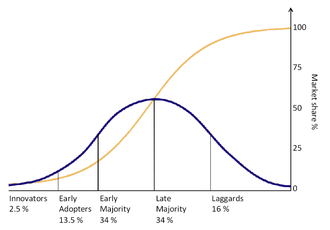
Everett Rogers published the Diffusion of Innovations in 1962, which clarified how people respond to change and new products.
Companies developed systems for launching innovations and building customer response. The film industry relied on critics to help sell films to audiences. Company web sites included reviews and customer comments. An expert system helped the flow of information and opinions to steer consumers in the desired direction.
What happened?
Amazon and eBay developed systems to include customer reviews on their sites. Consumers became accustomed to giving and receiving feedback from non experts about products and services. Company stooges were relatively easy to spot and ignore in making purchase decisions. These initiatives spawned a range of sites that included consumer reviews and feedback.
What happened next?
Other sites included a forum or discussion boards. Single issue fora focussed discussion around specific products and services. Other web sites included discussion boards about a range of topics and people had space to exchange views on a variety of consumer experiences. Regular visitors to these sites tended to ask fellow members for tips rather than turning to company websites.
What else happened?
Youtube hosted videos that showed how products worked. Some were made by the manufacturers, others by happy or dissatisfied users. Organisations and individuals began to show instruction films on how to do a range of things, including converting Youtube videos to audio files. Some were spoof reviews.
Peer to peer networking increased and companies were viewed as one element of the range of information sources available. Consumers might visit shops or websites to view the product, but looked around for the most competitive price online.
How did organisations respond?
Companies participated in discussion boards in 2 ways: 1) Staff provided helpful information and responded to feedback in positive and constructive ways, 2) Companies took web site hosts to court for publishing inaccurate or defamatory content. Some sites are now more cautious about content provided by consumers in contentious areas. Word gets round about the second tactic and does not boost sales.
Recently I emailed Apple about a problem with their product, which seemed to contravene consumer legislation on description of goods. They fobbed me off by directing me to tech support. I wrote to the Chief Executive (based in the USA) and the UK customer services manager was on the phone to me within a few days. She told me this was the first time she had heard a complaint about this particular problem. I pointed out that people had been discussing the issue for the last 4 years on their own web site fora.
If you don't use your own resources for listening to the customer, then they'll go elsewhere. If you don't or won't provide a solution to their problem, they'll find someone else who will.
Pubs may be closing every week in the UK, but people are finding virtual bars and cafes to gather, build relationships and exchange ideas about products and services. Even government experts no longer dominate:
The late majority and laggards may still respond to conventional systems, but the other 50% of the population comprising innovators, early adopters and early majority have voted with their feet and fingertips.
Russell Ackoff describes the evolution of companies from organisms to communities, in which people below elect their leaders. Perhaps the marketplace is evolving from distinct demographic strata into communities that are proactive and share ideas across demographic boundaries.
Customer relationship management (CRM) has become increasingly complex as customers don't necessarily gravitate to a company's website for information or to complain about their products.
The Age of Deference is over. Western culture is shifting towards participation, instant celebrity and a sense of entitlement. This seems to be spreading slowly around the globe, through franchised tv programmes.
In the UK, Members of Parliament failed in their attempt to conceal details of expense claims and MPs faced outrage and criticism in the press and in their constituencies for fiddling. Some have been prosecuted in court and gone to prison.
Julian Assange and his team have enabled people around the world to find out what their politicians have been saying behind closed doors as well as individuals who have stashed wealth in Swiss bank accounts out of reach from the tax authorities. He has revealed the extent of civilian casualties in war, which were previously concealed in general terms such as 'collateral damage'. He also disclosed inhuman and degrading practices outlined in the Guantanamo Bay handbook and the instruction to staff to lie to the Red Cross.
What do leaders and organisations do when embarrassing information is made public?
'In this situation, organisations have two choices, says Assange. One is to "engage in plans that the public will support if they are revealed", meaning that they will have nothing to fear from transparency. The other is to "spend additional resources to keep those plans secret". The second, more common, course entails a toll on the economic logic of the organisation, which Assange calls a "secrecy tax". Also, "when an organisation acts in a more clandestine manner", he says, "its own internal efficiency decreases, because information cannot flow quickly through the organisation. This is another form of secrecy tax." For organisations to be efficient, they should be transparent, he insists.'
I'm not sure that governments willingly favour increased transparency. I think it's likely that less communication will be committed to print in future in sensitive areas.
Colin Hutchinson, an inspirational sustainable development consultant, told the story of Norsk Hydro. Environmentalists climbed over the fence of their plant in Norway, took soil samples and publicised the details of their findings after analysis showed substantial heavy metal contamination. The company were aware of the problem, but hadn't publicised it. Instead of increasing security and quashing the story in the media, they developed a comprehensive sustainable development policy and employed environmentalists to train their staff. Colin documented a range of examples of organisations that were criticised for poor practice, but rose to the challenge and developed policies that took them far beyond the initial criticism.
Colin Hutchinson is no longer with us, but his pioneering work lives on.